

When disaster strikes, rescue teams often face more than damaged roads and buildings. Power may be out, communication systems may fail, and basic working facilities may be unavailable.
This is where an Emergency Support Vehicle becomes essential.
Instead of relying on damaged infrastructure, it brings power, lighting, communication equipment, storage, and other support systems directly to the scene. It can serve as a mobile command center, a temporary power station, or a field service platform for rescue teams and engineers.
In simple terms, it is a mobile base for emergency operations—ready to work wherever help is needed.

Table of Contents
What Is an Emergency Support Vehicle?
An Emergency Support Vehicle is a specially designed vehicle that provides mobile assistance during emergency response, disaster relief, maintenance operations, and remote field projects.
Unlike traditional transportation trucks, these vehicles are built around one key purpose: bringing essential operational capability to places where normal facilities cannot function.
Depending on the application, an emergency support truck can integrate:
- Mobile power generation systems
- Telescopic lighting equipment
- Communication and command systems
- Equipment storage compartments
- Maintenance tools
- Workshop facilities
- Rescue equipment
- Emergency supplies
The exact configuration depends on the customer’s mission. A power company may need a mobile energy solution, while a municipal rescue department may require a combination of lighting, tools, storage, and communication functions.
This flexibility makes emergency support vehicles suitable for governments, rescue organizations, utility companies, construction contractors, and industrial operators.
Why Organizations Need Emergency Support Vehicles?
Emergency operations are often limited by three major problems:
No electricity. No communication. No organized equipment support.
A damaged road or remote working environment can make it difficult to deploy traditional facilities. Building temporary infrastructure may take hours or even days, while emergency teams usually need solutions immediately.
An emergency support vehicle solves this problem by combining multiple support functions into one mobile platform.
Scenario 1: Disaster Relief in Areas Without Power
After a flood or earthquake, local power networks may stop working. Rescue teams need electricity for communication devices, lighting, pumps, medical equipment, and other tools.
A vehicle equipped with a generator system can provide temporary power immediately after arrival.
Solution:
A customized Emergency Power Supply Vehicle can operate independently from the grid and support emergency activities in remote areas.
Best Value:
- Faster deployment
- Reduced dependence on external infrastructure
- Continuous field operation
Scenario 2: Night Rescue Operations After Road Accidents
Rescue work does not stop when the sun goes down. In fact, some of the most difficult operations take place in the dark.
After a mountain road accident, for instance, damaged vehicles, fallen rocks, and uneven ground can make an already dangerous situation even harder to manage. A few portable lamps may help, but their coverage is usually limited. Someone also has to carry them, position them, and keep the cables and power supply under control.
That takes time.
A hydraulic lifting light tower changes the setup completely. Once the emergency support vehicle reaches the site, the lighting tower can be raised and powered by the vehicle’s own generator. Within a short time, a much larger working area can be illuminated.
Now rescue crews can see what they are doing. Recovery trucks can work more safely. Medical personnel have enough light to handle patients and equipment without relying on whatever temporary lighting happens to be available.
It is a simple idea, really.
Put the lighting system on the vehicle, bring the power with it, and take the working area wherever the rescue operation goes.
For night-time emergencies, that can turn an otherwise dark and difficult site into a usable temporary workstation.
Solution:
A mobile lighting system transforms the vehicle into a temporary emergency work station.
Best Value:
- Improved nighttime visibility
- Safer rescue environment
- Faster site preparation
Scenario 3: Remote Construction and Infrastructure Maintenance
Not every emergency comes with an earthquake or a flood.
Sometimes, the problem is much smaller — but just as inconvenient. A power line goes down. A machine stops working in the middle of a project. A remote construction site suddenly needs tools, electricity, or a place to carry out repairs.
For crews working in mining areas, large construction projects, oil and gas fields, or other remote locations, getting support equipment to the site can become a headache. One truck for the generator. Another for tools. Maybe a portable workshop on top of that.
Too many vehicles. Too much coordination.
A customized Emergency Support Truck takes a different approach. The generator, tools, storage areas, workbench, lighting equipment, and other field-service equipment can be installed on the same vehicle, depending on what the job actually requires.
The truck arrives, parks, and gets to work.
That matters when the site is several hours away from the nearest workshop or power source. Instead of moving equipment back and forth, maintenance crews have many of the things they need with them from the start.
It is not necessarily about having the biggest truck or the most equipment.
It is about having the right equipment in the right place when something goes wrong.
Solution:
A multi-purpose support vehicle can carry maintenance tools, welding equipment, compressors, spare parts, and power systems.
Best Value:
- Reduced equipment transportation costs
- Improved field productivity
- One vehicle for multiple tasks
4 Main Types of Emergency Support Vehicles
Emergency support vehicles are not limited to one standard design. Different industries require different solutions. The most common configurations include:
1. Emergency Power Supply Vehicle
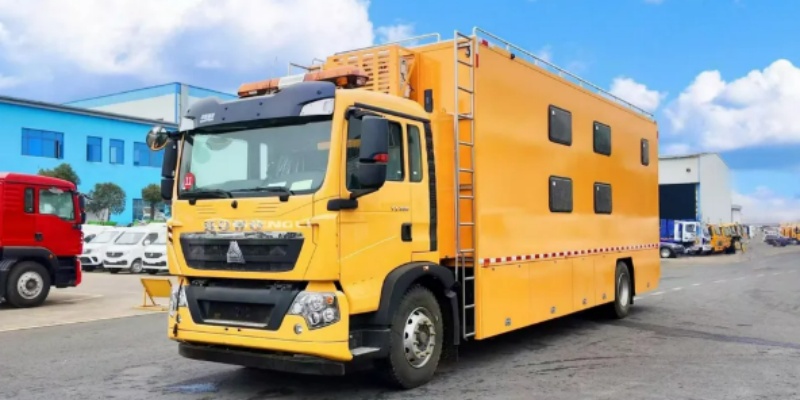
Electricity is easy to ignore — until it disappears.
A sudden blackout can stop communication systems, interrupt medical services, delay construction work, and create serious problems in places where backup power is not immediately available.
That is exactly the situation an Emergency Power Supply Vehicle is built for.
Instead of waiting for the damaged power network to be repaired, this vehicle can bring temporary electricity directly to the location where it is needed. A typical setup combines a generator system, electrical control cabinet, cable storage, and power distribution equipment into one mobile platform.
The advantage is simple.
The power source moves with the vehicle.
Take a communication tower after a heavy storm as an example. If the local power supply is damaged, technicians may not be able to restore the system immediately. An emergency power supply vehicle can reach the site, connect the equipment, and keep essential communication services running while permanent repairs are underway.
For many industries, this kind of support is not a luxury. It is a practical backup plan.
Power companies can use it during grid failures. Hospitals can rely on it during unexpected outages. Emergency departments and construction teams can bring stable electricity to locations where the normal power infrastructure cannot keep up.
2. Mobile Command Post Vehicle
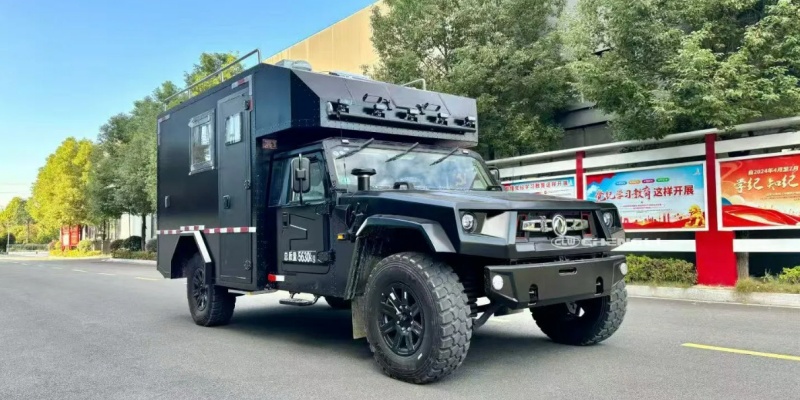
In a large emergency, these questions pile up fast. Phones may be unreliable, radio channels can become crowded, and working from an ordinary vehicle or an exposed roadside is hardly ideal.
That is where a Mobile Command Post Vehicle comes in.
Instead of setting up a temporary command room from scratch, response teams can bring one with them. The vehicle provides a protected workspace for commanders, communication staff, dispatchers, and other personnel who need to stay connected with what is happening on the ground.
Inside, communication and monitoring equipment can be installed according to the job. Workstations, radios, displays, power systems, and data equipment can all be arranged around the way the team actually operates.
Typical configurations may include:
- Workstations
- Communication equipment
- Monitoring systems
- Data management equipment
- Satellite communication solutions
Best For:
Government emergency departments, disaster management agencies, public safety organizations, and large event security teams.
3. Emergency Lighting Support Vehicle
An Emergency Lighting Vehicle focuses on providing reliable illumination in areas without sufficient lighting.
It is especially useful for:
- Nighttime rescue operations
- Road maintenance
- Accident recovery
- Temporary construction sites
A professional lighting system can cover a large working area while allowing operators to focus on rescue or repair tasks instead of manually arranging lighting equipment.
Best For:
Road rescue companies, municipalities, construction contractors, and emergency service providers.
4. Multi-Purpose Emergency Support Vehicle
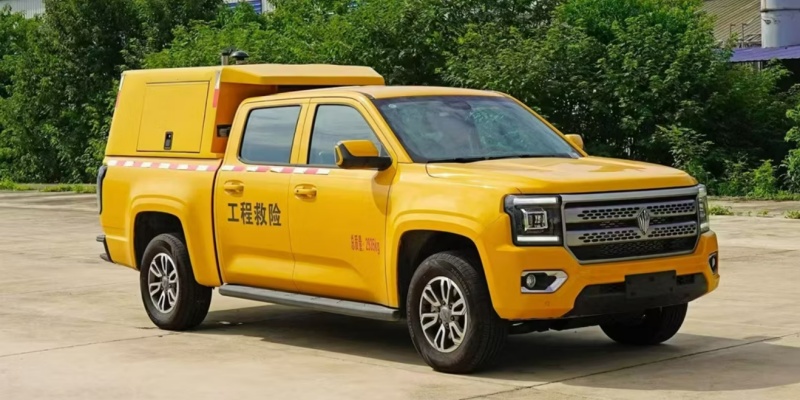
Some jobs need a generator. Others need tools, storage space, lighting, or a small workshop.
And sometimes you need all of them.
Buying a separate vehicle for every task can quickly become expensive, especially for organizations that work across remote areas or respond to different types of emergencies. You also end up managing more drivers, more maintenance schedules, and more logistics.
A Multi-Purpose Emergency Support Vehicle takes a simpler route.
One vehicle can be built around several functions. Power generation, equipment transportation, maintenance tools, cable storage, lighting systems, workbenches, and other equipment can be arranged according to the actual requirements of the operator.
A typical configuration may include:
- Generator system
- Tool storage
- Working platform
- Lighting equipment
- Maintenance facilities
This type of vehicle is especially valuable for organizations that need flexibility but have limited fleet budgets.
Best For:
Small and medium-sized municipal departments, contractors, and organizations requiring all-round emergency capability.
Key Features That Make Emergency Support Vehicles Effective
A professional Emergency Support Vehicle is not defined only by the equipment it carries. The real value comes from how different systems work together to create a reliable mobile operation platform.
For organizations purchasing these vehicles, the focus should not only be on specifications, but also on whether the vehicle can solve real operational challenges.
Reliable Chassis for Different Working Environments
Emergency support vehicles rarely get the luxury of working on perfect roads.
For this kind of vehicle, a strong chassis is more than a matter of carrying weight. It needs to support generators, tools, cabinets, water tanks, lighting towers, communication equipment, and other systems while the vehicle is operating for long hours.
A suitable chassis should be able to handle rough roads, uneven surfaces, frequent stops, and long-distance travel without turning every trip into a maintenance problem. Depending on the application, operators may also choose a heavy-duty or off-road configuration when the vehicle needs to reach areas that ordinary trucks simply cannot access.
- 4×2 chassis for urban emergency services and normal road conditions
- 4×4 chassis for off-road rescue and remote areas
- 6×4 or 6×6 chassis for heavy-duty applications and challenging environments
Selecting the correct chassis ensures that the vehicle can reach the emergency location safely and carry the required equipment.
Independent Power Generation System
Power availability is one of the biggest challenges during emergency operations.
When public electricity is unavailable, rescue teams still need energy for lighting, communication equipment, tools, and other systems.
An integrated generator system allows the vehicle to operate independently.
Depending on customer requirements, the vehicle can be equipped with:
- Diesel generator sets
- Power distribution cabinets
- Cable reels
- External power connection systems
- Battery storage solutions
For example, after a storm damages local power infrastructure, an emergency power supply vehicle can support repair teams by providing electricity directly at the work site.
The result is faster recovery with less dependence on temporary infrastructure.
Fast Deployment Lighting System
Visibility directly affects emergency efficiency and safety.
A modern emergency support vehicle can be equipped with a hydraulic or pneumatic telescopic lighting tower. The system can quickly extend above the vehicle and provide wide-area illumination.
In a nighttime rescue scenario, instead of manually installing multiple portable lights, the team can deploy a complete lighting solution within minutes.
Advantages include:
- Larger working coverage
- Reduced setup time
- Improved working safety
- Better support for rescue personnel
For emergency organizations, lighting is not an additional function — it is an essential operational capability.
Organized Equipment Storage
During emergency response, time is critical. Searching for tools wastes valuable minutes.
A customized equipment body allows every tool and component to have a designated location.
Storage solutions may include:
- Side cabinets
- Pull-out drawers
- Tool racks
- Lockable compartments
- External equipment boxes
A well-designed layout improves efficiency because operators can quickly access the equipment they need.
Communication and Command Capability
Large-scale emergency operations require coordination between multiple teams.
A vehicle equipped with communication and command systems can become a temporary operation center at the scene.
Possible equipment includes:
- Radio communication systems
- Monitoring displays
- Working desks
- Data transmission equipment
- Satellite communication systems
This capability is especially important when fixed communication facilities are damaged.
How to Choose the Right Emergency Support Vehicle
Selecting an emergency support vehicle is not simply choosing a truck with more equipment. The right solution depends on the actual mission, environment, and future operating needs.
Step 1: Identify Your Main Application
The first step is understanding what problem the vehicle needs to solve.
Different users have different priorities:
- Emergency departments may require command and communication functions.
- Power companies may focus on generator capacity.
- Construction companies may need tools and maintenance facilities.
- Rescue organizations may prioritize lighting and equipment storage.
A clear application purpose helps avoid unnecessary configurations.
Step 2: Define Required Equipment
Before purchasing, customers should create a list of essential equipment.
Consider:
- What tools need to be transported?
- How much electrical power is required?
- Is lighting equipment necessary?
- Does the team need a working area?
- Are communication systems required?
This information allows manufacturers to design a practical vehicle layout.
Step 3: Select the Suitable Chassis
The operating environment determines chassis selection.
For city-based operations, a compact vehicle may provide better flexibility.
For remote areas, disaster zones, or difficult terrain, a stronger chassis with higher mobility may be more suitable.
The correct chassis improves reliability and reduces maintenance problems during long-term operation.
Step 4: Plan the Vehicle Layout
A good emergency support vehicle should allow operators to work efficiently.
The body design should consider:
- Equipment access frequency
- Weight distribution
- Working space
- Safety requirements
- Future equipment upgrades
A professional manufacturer can optimize the layout based on actual usage scenarios.
Step 5: Choose a Customization Partner
Emergency requirements vary significantly between countries and industries.
A standard vehicle may not always match local conditions.
Working with an experienced manufacturer allows customers to customize:
- Vehicle size
- Chassis brand
- Generator capacity
- Lighting system
- Storage design
- Communication equipment
- Interior configuration
A customized solution provides better long-term value compared with a vehicle designed for general purposes only.
Why Customized Emergency Support Vehicles Are Becoming More Popular
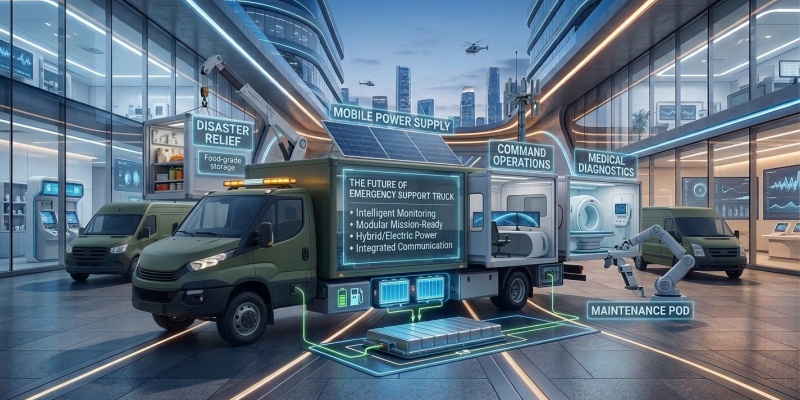
The demand for emergency support vehicles is increasing because organizations need faster and more flexible response capabilities.
A single vehicle can replace multiple traditional support units by combining:
- Transportation
- Power supply
- Lighting
- Communication
- Equipment storage
- Field maintenance
For many organizations, this means:
Fewer vehicles, faster deployment, and better operational efficiency.
Customization is especially important for international buyers because working conditions vary from country to country.
For example:
- African markets may require strong mobility for remote areas.
- Southeast Asian markets may focus on flood and storm response.
- Latin American markets may require solutions for infrastructure maintenance and disaster recovery.
A vehicle designed around local needs can provide better performance in real applications.
Emergency Support Vehicle Applications Around the World
Disaster Response
During earthquakes, floods, hurricanes, and other natural disasters, emergency support vehicles provide essential resources when normal infrastructure is damaged.
They help rescue teams establish temporary operation bases and continue working in difficult conditions.
Utility Maintenance
Electricity, water, and telecommunications companies often need rapid repair solutions.
An emergency support truck can carry technicians, tools, spare parts, and power equipment directly to the maintenance location.
Mining and Remote Industry
Mining areas are usually far from urban facilities.
In these environments, emergency support vehicles provide mobile workshops, power supply, and maintenance assistance.
Large Public Events
Concerts, exhibitions, and sports events require reliable temporary support systems.
Emergency support vehicles can provide power, lighting, and communication support throughout the event.
Ready to Build Your Emergency Support Vehicle?
An Emergency Support Vehicle is not simply a truck that carries equipment from one place to another.
In the field, it can become the power source, the workshop, the command room, or even the place where a support team prepares meals and takes care of daily operations. What goes on the vehicle depends largely on where it will be used and what your team needs to accomplish.
A remote construction project may need a Power Supply Truck with a reliable generator and distribution system. An emergency response team could need a Mobile Command Post Truck for communication and on-site coordination. For long-duration operations, a Kitchen Food Cooking Support Truck can provide a practical way to prepare and serve meals directly at the working location.
Then there are projects that need several functions at once.
In that case, a Multi-Purpose Emergency Support Vehicle may make more sense than purchasing several specialized trucks. Power equipment, tools, storage areas, lighting, communication systems, and other facilities can be arranged on one vehicle according to the actual job.
There is no single configuration that works everywhere.
A vehicle designed for a city emergency department may look very different from one built for a mining project in a remote area. Terrain, climate, working hours, available infrastructure, equipment weight, and the number of people using the vehicle all have to be considered before the design is finalized.
That is where customization becomes useful.
Instead of starting with a fixed truck and trying to make it fit the job, you can start with the job itself. Tell us where the vehicle will operate, what equipment you need to carry, and what your team expects it to do. Our engineering team can then work around those requirements to develop a suitable Emergency Support Vehicle.
Sometimes the best emergency vehicle is not the one with the most equipment.
It is the one that has exactly what your team needs when the usual infrastructure is no longer there.
Contact us today to discuss your Emergency Support Vehicle project
