

When your crew faces a sewer line packed with hardened sediment that feels like wet concrete, or a deep manhole with suction requirements far beyond standard reach, you need more than just a truck. You need a reliable CLW sewage suction truck that delivers consistent, powerful suction when it matters most. This is where CLW vacuum sewage trucks separate themselves from the ordinary.
Many guides explain the basic principle—a vacuum pump extracts air, creating negative pressure, and atmospheric pressure forces waste into the tank. That is technically accurate, but it oversimplifies the real-world challenges that determine success or failure on the job. For a CLW sewage suction truck, the difference lies in the engineering details that make it perform when standard trucks fail.

Table of Contents
Sustained Vacuum Flow vs Peak Vacuum Numbers
Many fleet managers focus on one number when evaluating a CLW sewage suction truck: maximum vacuum degree (e.g., -0.9 bar). But the metric that truly drives productivity is the pump’s sustained air extraction rate under high vacuum load. When the suction hose penetrates thick oily sludge or debris mixed with gravel, the line pressure spikes instantly.
- Standard pumps: When resistance increases, their extraction rate drops sharply, causing suction power to plummet and materials to stall in the hose—creating an “air lock.”
- CLW’s high-performance water-ring or Roots pumps: Engineered for continuous heavy-duty operation. Even under significant negative pressure, they maintain robust airflow velocity, keeping the solid-liquid mixture moving steadily through the line. This is why a CLW sewage suction truck efficiently extracts mud, gravel, and even small bricks without frequent clogs.
Smarter Tank Design for Cleaner Discharge
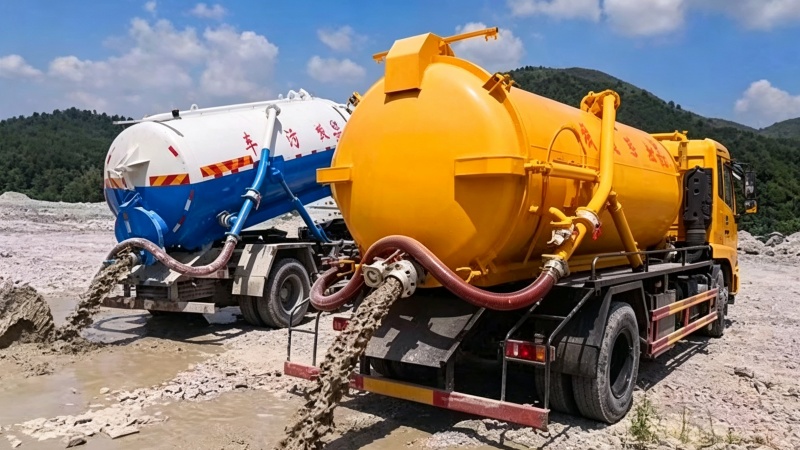
Extracting waste is only half the job for any CLW sewage suction truck. If the tank lacks proper internal design, heavy sand and grit will quickly settle to the bottom—reducing effective payload and creating discharge headaches. You might end up spending excessive time flushing out compacted layers.
CLW’s circular tank is built not only for pressure resistance but also for efficient unloading. Its internally optimized baffle plates and precisely angled discharge geometry, combined with the hydraulic tilting system’s accurate angle control, ensure:
- During transport: Internal structures minimize liquid surge, improving stability and road safety.
- During rapid discharge: Even the heaviest, most viscous sediments slide out cleanly via pressurized discharge and steep tank tilt—reducing residue, maximizing net payload per trip, and cutting cleanup time. This makes every CLW sewage suction truck more productive per shift.
Built for the Long Haul: PTO and Hydraulic Durability
The service life of a CLW sewage suction truck often depends not on the engine, but on the durability of its power take-off (PTO) and hydraulic system. The PTO draws engine power to drive both the vacuum pump and hydraulics—this is the most stressed link in the entire drivetrain.
- Common pitfalls: Low-cost manufacturers use generic PTO units that overheat or suffer shaft failure under prolonged, high-intensity suction cycles.
- CLW’s solution: We employ purpose-built, heavy-duty PTO units precisely matched to mainstream chassis (such as Dongfeng and Sinotruk), complemented by an optimized hydraulic oil cooling circuit. This means even during extended summer shifts, a CLW sewage suction truck maintains safe operating temperatures—drastically reducing unplanned downtime and repair costs.
Three Questions to Find Your Ideal Configuration
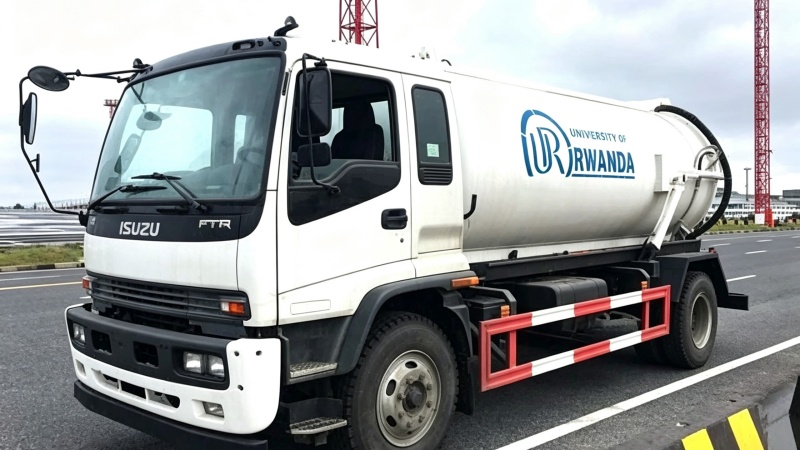
When you request a quotation for a CLW sewage suction truck, please come prepared with answers to these three questions—they help us recommend the most cost-effective configuration for your specific needs, not just the most expensive one:
- What is the primary waste type? Is it ordinary municipal sewage, grease-laden restaurant effluent, or acidic/chemical industrial sludge? (This determines whether your CLW sewage suction truck needs a carbon steel tank with anti-corrosion coating or a full 304 stainless steel tank.)
- What are your typical horizontal suction distances and vertical lifts? Are you pumping from street level, or from deep shafts 8–10 meters down? (This defines the required maximum vacuum rating for your CLW sewage suction truck.)
- What is your daily operating frequency? Are you doing one or two loads per day, or continuous high-frequency work? (This dictates whether you need a standard or reinforced pump and PTO package for your CLW sewage suction truck.)
Conclusion: CLW Sewage Suction Truck
Choosing a CLW sewage suction truck means investing not just in a vehicle, but in a targeted solution for your city’s unique underground challenges. We don’t just sell concepts—we deliver reliable equipment with sustained vacuum flow, smart tank engineering, and a fully harmonized powertrain, ready to perform when you face the most stubborn blockages.
Every CLW sewage suction truck is built with the understanding that no two jobs are the same. That’s why we prioritize customization over one-size-fits-all solutions.
Ready to upgrade your fleet’s “heavy-lifting” capability with a CLW sewage suction truck? Contact the CLW engineering team, share your actual working conditions, and we’ll provide a tailored specification recommendation within 24 hours.
