

Is milk tanker clean? Before the milk in your refrigerator reaches the supermarket shelf, it may have already traveled hundreds of kilometers inside a specially designed milk tanker truck. This vehicle plays an important role in safe and hygienic milk transport.
But here is a question many people may ask: if milk is transported inside such a large tank, how can we ensure that the milk tanker remains clean and safe?
The answer depends on how the vehicle is designed, cleaned, and operated. Unlike an ordinary liquid transport vehicle, a milk tanker truck is specifically designed for milk transportation and other food-grade liquid transport applications.

Table of Contents
How Milk Tanker Trucks Ensure Safe Transport
A milk tanker is not simply a truck with a large milk tank mounted on its chassis. Its tank and related components are designed to support hygienic milk transport.
1. Food-Grade Tank Materials
Milk comes into direct contact with the inner surface of the tank, pipelines and valves during transportation. For this reason, milk tankers are commonly manufactured using food-grade stainless steel, such as SUS304 stainless steel. SUS316L stainless steel can also be selected for applications requiring higher corrosion resistance, such as transporting certain dairy liquids with higher acidity.
2. Smooth Interior and Hygienic Design
The interior of a milk tanker is designed with a smooth and hygienic surface to reduce the accumulation of milk residues during transportation. A well-designed tank interior minimizes dead corners and areas where bacteria can grow, making the cleaning process more efficient. In addition, the internal structure, welding points, pipelines and valves of a professional milk tanker are designed to meet food transportation requirements. This helps maintain hygiene conditions and reduces the risk of contamination during milk transport.
3. Professional Cleaning
Cleaning is one of the most important parts of milk transport. Depending on the configuration and operating procedures, milk tankers may be equipped with CIP (Clean-in-Place) systems, which allow the tank and related pipelines to be cleaned without disassembly. These systems use circulating water and cleaning solutions under controlled conditions to help remove milk residues and reduce bacterial contamination risks.
4. Sealed Transportation
A properly designed milk tanker uses a sealed tank system with hygienic valves and pipelines to help reduce the risk of external contaminants entering the tank during transportation and maintain milk quality.
5. Insulation and Product Protection
Depending on transport conditions and climate requirements, milk tankers can be equipped with insulated tank structures to help reduce temperature changes during transportation and protect milk quality, especially during long-distance transport.
For this reason, the question is not simply, “Is the milk tanker clean?” A better question is whether the tanker is properly designed, cleaned, and operated for hygienic milk transport.
Can you drink milk directly from a milk tanker? Generally, no. The milk transported by a milk tanker truck is usually raw milk collected from dairy farms or collection points. It is delivered to a dairy processing facility, where it undergoes testing, processing, and heat treatment before being packaged for consumers.
A simplified milk transport process may look like this:
Dairy Farm → Bulk Milk Tank → Milk Tanker → Dairy Processing Plant → Testing & Processing → Packaging:
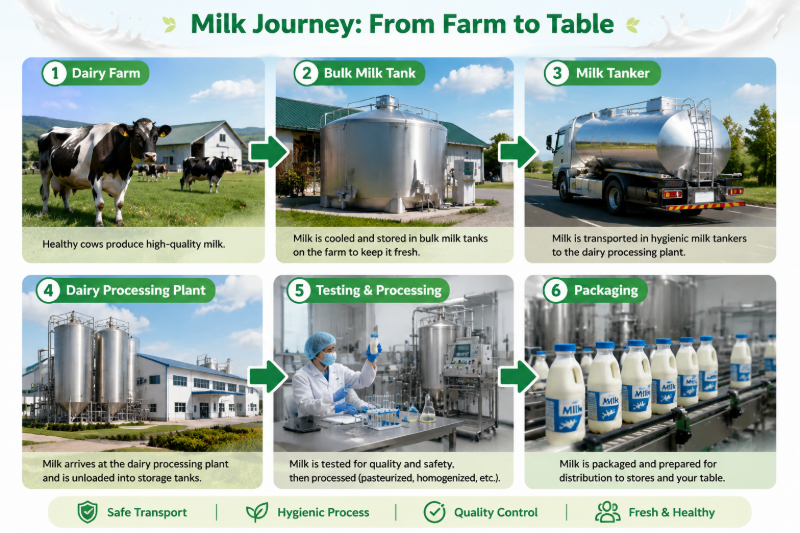
This is where the milk tanker plays an important role. It connects the milk collection stage with the dairy processing stage.
Milk Tanker vs. Water Tanker: Why Are They Different?
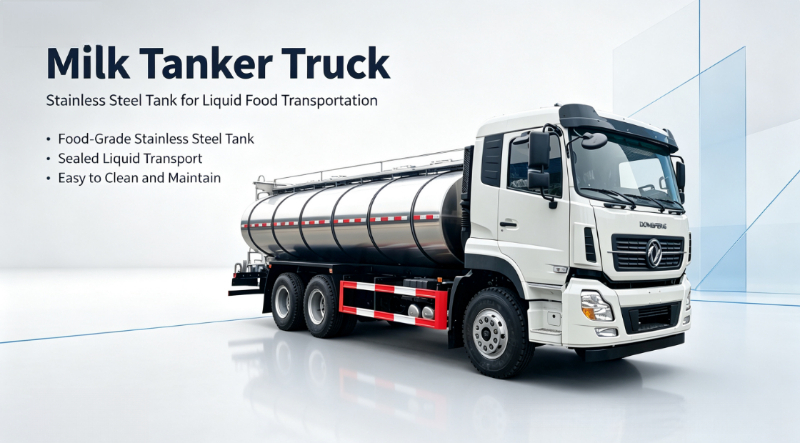
At this point, another question naturally appears: if milk is a liquid, why can’t a water tanker be used for milk transport?
The answer is simple: a clean tank is not necessarily a food-grade tank.
Milk transportation is not only about removing visible dirt. The tank material, construction design, internal surface, pipelines, valves, cleaning requirements and product protection systems all play an important role in maintaining milk quality.
A milk tanker truck is designed specifically for transporting food products, while a water tanker truck is designed mainly for water transportation applications. Although both vehicles use tanks to carry liquids, their design purposes and hygiene requirements are completely different.
At first glance, a milk tanker truck and a water tanker truck may look similar. Both vehicles are equipped with large tanks and designed to transport liquids. However, their purposes, materials, and hygiene requirements are very different.
| Feature | Milk Tanker Truck | Water Tanker Truck |
|---|---|---|
| Primary Purpose | Transporting raw milk and dairy liquids from farms to dairy plants | Transporting or distributing water for different applications |
| Tank Material | Food-grade stainless steel, commonly SUS304 or SUS316L | Selected according to water transport requirements |
| Food Contact Design | Designed for food hygiene and dairy transportation requirements | Not designed for food-grade liquid transportation |
| Tank Interior | Smooth and polished interior surface for easier cleaning and residue reduction | Designed mainly for water storage and transportation |
| Cleaning Requirements | Requires strict hygienic cleaning procedures, including CIP systems when equipped | Cleaning requirements depend on water usage and application |
| Piping & Valves | Hygienic pipelines and valves designed for dairy liquid transport | Standard liquid transport components |
| Sealing System | Designed to reduce contamination risks during transportation | Designed according to water transport needs |
| Insulation | Available when temperature control is required | Usually not required |
| Typical Application | Raw milk collection and transportation to dairy processing plants | Water delivery, irrigation, construction and road spraying |
The Key Difference Is Not Just the Tank
A water tanker may be clean, but that does not automatically make it suitable for milk transport.
The main difference is how the entire vehicle is designed.
A water tanker is designed to move water efficiently. A milk tanker is designed around food hygiene, product protection, and hygienic milk transport.
In other words, a milk tanker is not simply a water tanker carrying milk.
What Should Buyers Look for in a Milk Tanker?
For dealers, importers, and fleet operators, choosing a milk tanker involves more than selecting a tank capacity.
Important factors include:
1. Milk Tank Capacity
Choose the tank capacity according to local milk collection volume, transport distance, and operational requirements.
2. Tank Material
Select suitable food-grade stainless steel according to the product being transported and local requirements.
3. Single or Multiple Compartments
Multiple compartments may be useful when different milk sources or delivery requirements need to be handled separately.
4. Insulation Requirements
Consider local climate, transport distance, and milk handling requirements when selecting the insulation configuration.
5. Cleaning System
A suitable cleaning system can help improve operational efficiency and support hygienic tank maintenance.
6. Piping and Valve Configuration
The design of pipelines, valves, and discharge systems should match the intended milk transport and unloading process.
7. Chassis Configuration
The chassis should be selected according to tank capacity, payload requirements, road conditions, and local regulations.
Conclusion: Is Milk Tanker Clean
So, is a milk tanker clean? The answer isn’t a simple ‘yes’ or ‘no’ — it depends on design, material, and daily maintenance. A professional milk tanker is not a water carrier; it’s a mobile food processing facility. From 316L stainless steel interiors to automated CIP cleaning, every detail matters in protecting the dairy supply chain.
Choosing the wrong tanker configuration can lead to higher maintenance costs, product loss and inefficient transportation. Tank capacity, insulation, chassis selection and unloading requirements all influence the final performance.
CLW can provide customized milk tanker solutions based on your transport distance, road conditions and dairy business requirements.
Contact CLW today and let’s find the right milk tanker for your business.
