

Fire rescue trucks are called upon when standard pumpers simply cannot do the job. A serious highway crash pins victims inside twisted metal. A collapsed building traps survivors under debris. A worker gets stuck in a narrow trench or shaft. In all these technical rescue scenarios, water and hoses are useless—what saves lives is a different set of tools. Fire rescue trucks are packed with hundreds of professional rescue tools: hydraulic cutters and spreaders, lifting air bags, shoring equipment, generators, and lighting systems. This article explores this “toolbox on wheels” and its critical role in emergency response.

Table of Contents
Fire Rescue Truck vs. Fire Engine: What’s the Difference?
Many people confuse rescue trucks with standard fire engines, but they serve fundamentally different missions.
A fire engine is designed to supply water and extinguish fires. It carries a pump, water tank, and large quantities of hose. A fire rescue truck is designed to save lives. It carries hydraulic rescue tools, shoring equipment, lifting devices, rope systems, generators, and lighting equipment — but no water.
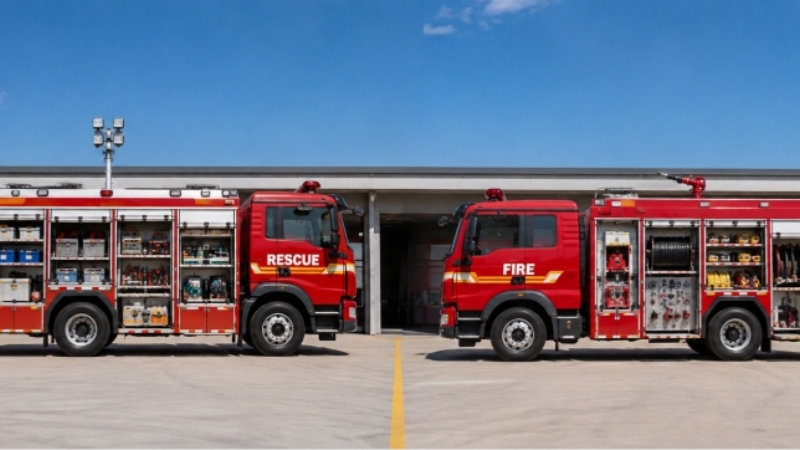
In simple terms: fire engines put out fires; rescue trucks cut, lift, shore, and extract victims. On the fireground, they work together — the engine suppresses the fire while the fire rescue truck opens the life-saving path.
What Problems Do Fire Rescue Trucks Solve?
1. Vehicle Extrication in Traffic Accidents
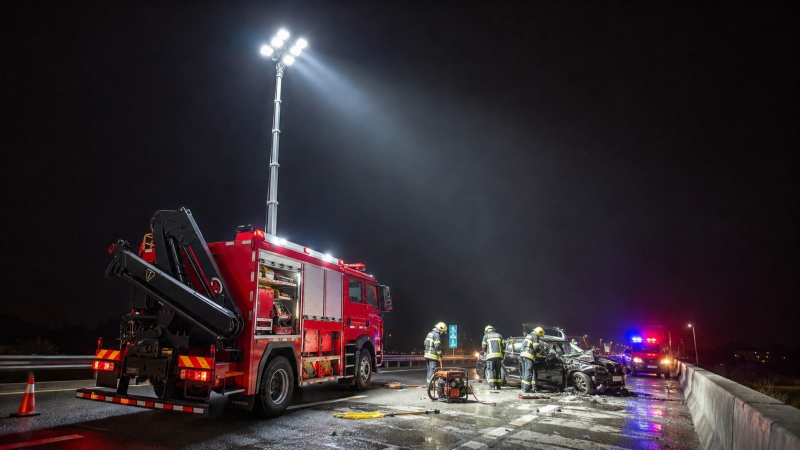
In severe highway collisions, victims are often pinned inside deformed vehicles. Ordinary tools cannot quickly cut through the high-strength steel used in modern cars. Rescue trucks carry hydraulic spreaders, cutters, and rams — collectively known as the “Jaws of Life” — which can cut through A-pillars, B-pillars, and pry open crushed doors and dashboards in minutes.
2. Building Collapse and Confined Space Rescue
In earthquakes, building collapses, or trench cave-ins, victims may be buried under debris or soil. Rescue vehicles carry pneumatic lifting airbags capable of raising tons of weight; shoring struts to stabilize collapsed structures and prevent secondary collapse; and confined space rescue equipment for safe entry into shafts, pipes, and other tight spaces.
3. High-Angle and Rope Rescue
On cliffs, high-rise buildings, or bridges, victims may be stranded at height or in deep ravines. Rescue trucks carry rope rescue systems — including main lines, belay lines, descenders, ascenders, and stretcher attachment devices — for professional high-angle rescue operations.
4. Scene Lighting and Power Supply
When working at night or in underground locations, good lighting is usually the top priority. Fire rescue trucks come with built‑in generators and large lighting masts, which can light up the entire work site as bright as daylight. Generators also provide continuous power for electric rescue tools and communication equipment.
What Equipment Does a Fire Rescue Truck Carry?
A typical fire rescue truck carries equipment across several categories:
1. Hydraulic Rescue Tools (The Jaws of Life)
This is the core equipment, including:
- Hydraulic spreaders — to pry open crushed doors and dashboards. Typical maximum opening distance ranges from 28 to 40 inches (710 to 1,016 mm). High-end models like the Hurst M40 achieve a 40-inch (1,016 mm) opening — the widest battery-operated spreader on the market. Spreading force can exceed 187,000 lbs (836 kN).
- Hydraulic cutters — to cut through A-pillars, steering wheels, and high-strength steel. Cutting force typically ranges from 120,000 to over 300,000 lbs. Advanced cutters can shear up to 45 mm diameter steel rebar and cut through 20 mm thick steel plate. NFPA cutter ratings for high-end combi tools reach A7/B8/C7/D8/E7/F4.
- Hydraulic rams — to lift dashboards and steering columns, creating space for victims. Extension force typically exceeds 50,000 lbs, with some models capable of displacing dashboards by more than 50 inches (1,270 mm) to free trapped occupants.
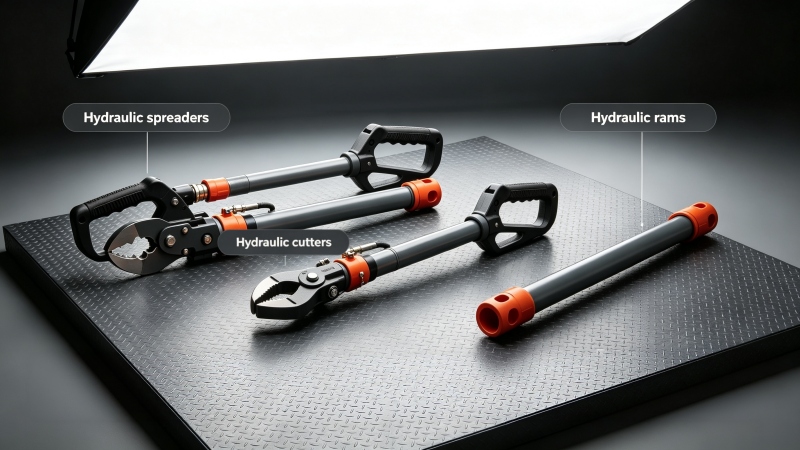
These three tools are collectively known as the “Jaws of Life”.
2. Shoring and Stabilization Equipment
- Struts — to provide temporary shoring in vehicles or collapsed structures.
- Air lifting bags — to lift heavy loads, capable of raising tens of tons. Air lifting bags must meet NFPA 1936 performance requirements.
- Cribbing — for stabilization and support.
3. Rope and Confined Space Rescue Equipment
- Rope rescue systems — main lines, belay lines, descenders, ascenders, stretchers
- Confined space communication systems — hardline communications to maintain contact with ground teams
4. Lighting and Power Systems
- Onboard generators — to provide scene power
- Large lighting masts — to illuminate the scene for safe night operations
5. Additional Support Equipment
- Thermal imaging cameras — to locate victims in smoke or darkness
- Self-Contained Breathing Apparatus (SCBA) — to ensure firefighter safety in toxic or oxygen-deficient environments
- Cutting tools — chainsaws, concrete cutters, etc.
- Winches — for pulling and towing
Who Benefits from Fire Rescue Trucks?
- Every minute is critical for victims trapped in traffic accidents. Hydraulic rescue tools allow crews to extricate casualties within the golden rescue window, which greatly reduces the risk of severe, life‑altering injuries.
- In collapse‑rescue scenarios, shoring struts pneumatic and mechanical) and lifting airbags stabilize hazardous structures and lift heavy debris. They create crucial time for rescue teams to access survivors safely.
- For front‑line firefighters, proper equipment is far more than a convenience — it is a safety requirement. Specialized tools lessen physical stress, accelerate extrication work, and minimize secondary‑injury risks in complex operations.
- From fire chiefs and fleet managers‘point of view, one well‑equipped rescue truck shortens response times for various incident types. It reduces long‑term maintenance costs and maximizes return on your apparatus investment.
What’s Next?
A fire rescue truck carries no water, yet it is an indispensable core of any fire service‘s rescue capability. It doesn’t spray water, but it cuts through crushed vehicles in traffic accidents. It doesn’t extinguish flames, but it lifts tons of debris in building collapses. From hydraulic rescue tools to shoring struts, from rope systems to lighting and generators — every piece of equipment serves one mission: save as many lives as possible, in the shortest possible time.
Ready to equip your city or fire department with a professional fire rescue vehicle?
Contact our fire apparatus experts today for a customized rescue truck selection and configuration assessment — and provide the most reliable equipment support for every rescue mission.
