

When looking for an aerial work platform truck for sale, working height is often the first specification buyers check. But a truck that reaches the right height may still be unsuitable for the site. It might struggle at the entrance, need more space for its outriggers, or fail to reach the work position with the required load.
Before comparing quotations, gather a few measurements and photographs from your usual jobs. These help the supplier assess the vehicle against the places where you will actually use it.
The six checks below focus on that match: getting into the site, setting up, and reaching the work with people and tools on board.
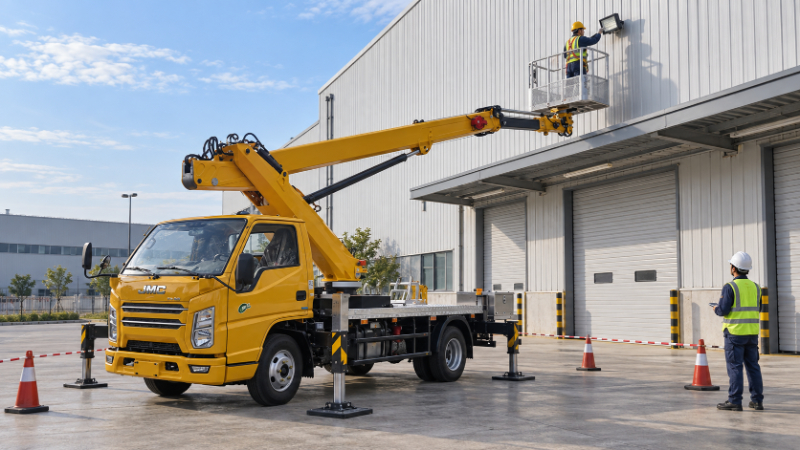
Table of Contents
Why Working Height Alone Is Not Enough
Consider a hypothetical warehouse repair job. The work point is 18 m above ground, but a loading canopy prevents the truck from parking close to the wall. Two workers also need tools and repair materials in the basket.
Would a truck advertised with a 20 m working height be suitable? The height figure alone cannot answer that question. The supplier also needs the parking position, horizontal distance, canopy dimensions and total basket load.
For a truck-mounted aerial work platform, ask for the working envelope: the manufacturer’s chart showing the permitted reach under stated conditions. Confirm whether vertical figures refer to platform floor height or working height, which includes an allowance for a person’s reach.
Do not assume that maximum height and maximum horizontal outreach are available together. Ask the supplier to identify your required position on the correct chart. This turns a general promise about height into a specific question about the job.
6 Site Checks Before You Choose a Truck
1. Can the Truck Enter and Turn at Your Site?
Start at the entrance. Measure the clear gate opening and the lowest overhead clearance. Photograph any tight turn between the road and the yard. For the warehouse example, include the approach to the loading area, not just the main gate.
Ask for the aerial work platform truck’s overall length, width and height in its stowed travel position, plus turning information. Clarify whether the stated width includes mirrors and whether fitted accessories affect clearance.
A wide gate does not settle the turning question. Send a sketch showing gateposts, nearby walls and the approach angle. Ask the supplier to check the proposed vehicle against that layout before you accept its dimensions as suitable.
2. Is There Enough Space to Deploy the Outriggers?
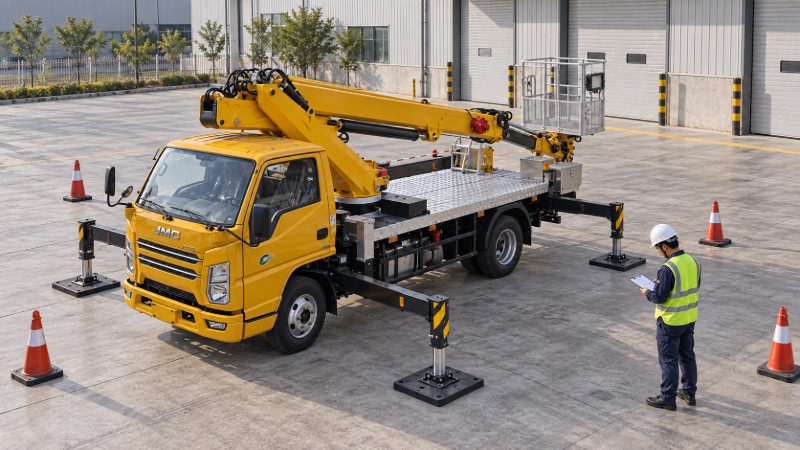
A parking bay may fit the vehicle while leaving too little room for its supports. Mark the usable setup area and note walls, kerbs, loading doors and traffic lanes that must remain clear.
When comparing a bucket truck for sale, request an outrigger layout drawing, including the space needed for support pads. Ask which setup the quoted working range assumes.
Do not assume the legs can simply be extended halfway. If a model allows variable or one-sided extension, request its approved configurations and the working limits for each. For the warehouse job, have the supplier assess the proposed position beside the canopy. A photograph of the boom lift truck with fully extended outriggers does not demonstrate that a restricted setup will work.
3. Can the Platform Reach the Actual Work Position?
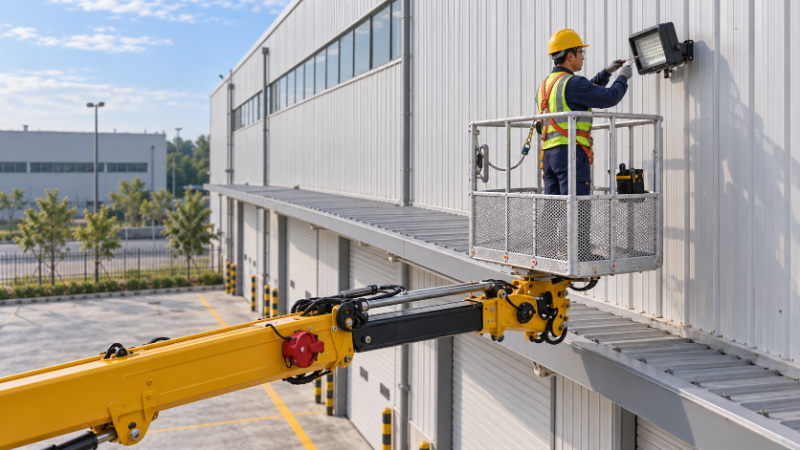
Mark the work point and proposed parking position on the same drawing. Include the vertical height and horizontal separation, with clear labels showing where each measurement starts and ends.
Ask the supplier to assess the boom lift truck using those measurements. Outreach may be measured from a reference point on the machine; a distance measured from its nearest tyre is not automatically the same figure.
Request a marked working envelope for the proposed load and support configuration. The marked point should represent your actual task, not just the furthest reach shown in the brochure.
If the location falls outside the permitted envelope, discuss a different parking position or model. Do not treat a small shortfall as something the worker can solve by leaning beyond the basket.
4. Does the Required Reach Allow for People and Tools?
Prepare a basket load list for the boom lift truck. Count the people, protective equipment, tools and materials that will be carried together.
For illustration, two workers at 85 kg each, plus 30 kg of tools, materials and protective equipment, total 200 kg. This is a hypothetical load calculation, not a capacity recommendation or approval for any vehicle.
Ask the supplier to confirm the permitted number of occupants and the working envelope at that total load. A headline basket capacity should not be assumed to apply at every position or support arrangement.
For the warehouse repair, also list bulky replacement parts. Weight alone will not tell you whether the workers have enough usable basket space to handle them. Confirm any material-handling arrangements with the manufacturer.
5. Can the Boom and Basket Clear Obstacles?
A work point inside the reach chart still needs an unobstructed approach. The warehouse canopy may interfere with the boom before the basket reaches the wall.
Send side-view photographs and dimensions showing the canopy’s height and projection. Include roof edges, pipes and other structures near the task. Ask how the proposed boom lift truck would approach and leave the working position.
Check basket dimensions, rotation and the movement of any jib, the smaller arm near the basket. Request a movement drawing or demonstration relevant to your layout. A demonstration in an open yard cannot establish clearance around your canopy.
Assess the whole movement path, including the boom and basket. Any overhead electrical lines require a separate competent assessment; a reach drawing does not establish electrical safety.
6. Can the Ground Support the Planned Setup?
Record the ground surface, slope and any known underground features at the proposed support positions. Ask the site owner about buried services, tanks, drains and recently backfilled areas.
The HSE’s MEWP guidance identifies trenches, manholes and uncompacted ground as overturning concerns. A paved surface alone is not evidence that it can support the machine.
For the selected truck-mounted aerial work platform truck, request the manufacturer’s outrigger reactions: the forces transferred through its supports. Obtain its levelling limits and support requirements too.
Have a competent person compare those requirements with the site’s bearing capacity and determine suitable support arrangements. Do not estimate the load on each leg by dividing the vehicle’s weight equally. If the ground information is missing, resolve that before confirming the setup.
What to Send Your Supplier for a Suitable Recommendation
When comparing an aerial work platform truck for sale, send each supplier the same site information. Otherwise, quotations may be based on different assumptions about parking space, load or reach.
Use this short enquiry checklist:
| Information | What to provide |
| Work task | The repair, installation or inspection to be performed |
| Site access | Gate width, overhead clearance and photographs of turns |
| Setup area | Available space, parking position and nearby traffic routes |
| Work position | Required height and horizontal distance, with reference points |
| Obstacles | Canopy dimensions, roof edges and other obstructions |
| Basket load | Occupant numbers and total weight of people, equipment and materials |
| Ground information | Surface, slope, known underground features and available bearing data |
| Destination | Country of use and any known registration or project requirements |
If your enquiry describes a boom lift truck, include a photograph or vehicle description so the supplier understands the equipment you mean. The same applies when responding to a bucket truck for sale listing: confirm the actual configuration offered.
Ask for the proposed model, marked reach chart, outrigger drawing and written assumptions with the quotation. Keep these documents together when comparing offers. For broader planning, the HSE selection guide also covers access, positioning and site conditions.
Conclusion
The right aerial work platform truck should fit your site and reach the work point with the people and tools you need. Before buying, check site access, outrigger space, working reach, basket load, nearby obstacles and ground conditions. Share your site measurements with the supplier and confirm the proposed model’s limits before placing an order.
Looking for an aerial work platform truck for sale that fits your next project?
Contact CLW for your customized solution. Send us your site photos, required working height, horizontal reach, and the total weight of people and tools in the basket. Include your destination country. We can help you compare suitable configurations and provide a detailed quotation based on your requirements.
