

“Will the range be enough?” “What happens when the battery degrades?” “How long before the price premium pays back?” — these are the questions every fleet manager asks before switching to electric sanitation vehicles. Electrification is inevitable, but “is it worth buying” cannot be answered with slogans.
This article uses the Dongfeng Huashen pure-electric sewage suction truck, a 2025–2026 platform model from Chengli, as a case study — analyzing range, charging, operating costs, and application boundaries with real specifications to support a data-driven purchasing decision.
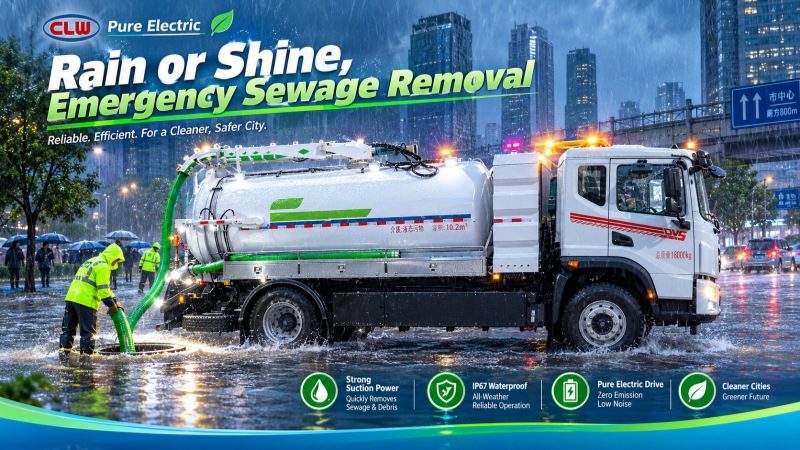
Table of Contents
What Can This Electric Sewage Suction Truck Do?
Before discussing value, let’s look at what it can accomplish. Here are the core specifications:
| Parameter | Specification |
|---|---|
| Gross vehicle weight | 18,000 kg |
| Curb weight | 10,000 kg |
| Tank capacity | 10.24 m³ |
| Battery | 165.68 kWh |
| Wheelbase | 4500 mm |
| Vacuum pump | Hydraulically driven vacuum pump |
Data source: Chengli Special Automobile / Dongfeng Huashen official homologation and product documentation (actual delivery configuration may vary).
Three key takeaways: the 10 m³-class tank is the mainstream municipal capacity; the 165.68 kWh battery is a large-capacity configuration for this class; and the dual mechanical/electrical PTO system ensures the vacuum pump has an independent power source, decoupled from the drive motor.
Is the Range Enough?
The range question needs a different calculation for sanitation vehicles.
For sanitation work, the metric is not “how many kilometers per day” but “how many hours of productive work per day.” An electric sewage suction truck typically drives 80–120 km per day, spending the rest of its time suctioning and discharging at job sites.
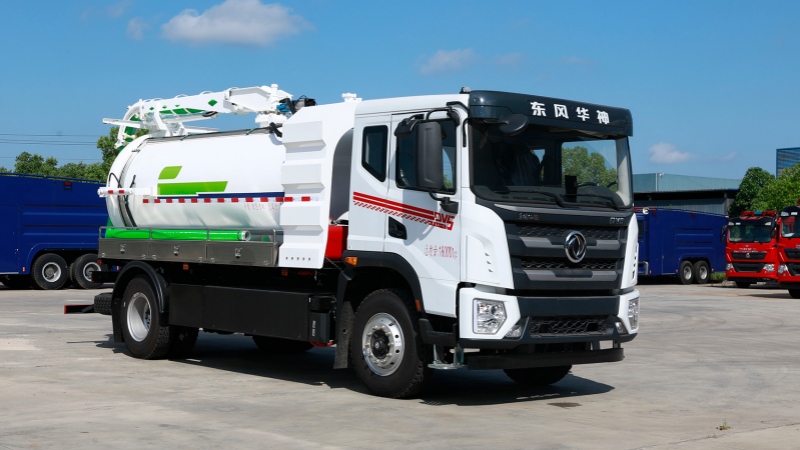
With a 165.68 kWh LFP battery, under typical sanitation duty cycles (low-speed driving, frequent stops, intermittent pump operation), a single full charge supports 6–8 hours of productive work. For a single-shift (8-hour) municipal fleet, one charge per day covers a full shift.
One caveat: if your operating radius exceeds 100 km or requires over 8 hours of continuous cross-district work, you’ll need mid-shift charging or shift rotation — a boundary condition to evaluate before purchase.
Will Charging Disrupt Operations?
The real barrier to electric sanitation isn’t the truck — it’s how charging infrastructure aligns with your scheduling.
The vehicle supports both standard and fast charging. For the typical overnight parking scenario: 8–10 hours of slow charging overnight provides a full battery for the next day’s morning shift. This “charge at night, work by day” pattern fits municipal scheduling with minimal disruption.
When mid-shift charging is required, evaluate three items before purchase. Does your depot have 380V power? Do your chargers match your fleet scale? Are you running two shifts? For two-shift fleets with poor charging infrastructure, electric vehicles lose most of their edge.
How Much Do You Save Each Month?
This is the core of the decision. Here’s a conservative calculation based on the following assumptions:
Cost calculation assumptions:
- Daily driving distance: 100 km; 25 working days per month
- Diesel reference price: ¥7.5/L (2025–2026 range)
- Industrial electricity: ¥0.8/kWh (including partial service fees; actual peak/off-peak rates may be lower)
- Excludes differences in maintenance costs, purchase tax exemptions, and local subsidies
Assume a 10 m³ electric sewage suction truck drives 100 km per day, 25 days per month:
| Item | Diesel Truck | Electric Truck |
|---|---|---|
| Energy use per 100 km | ~25–30 L diesel | ~60–70 kWh |
| Unit price | ¥7.5/L (reference) | ¥0.8/kWh (industrial rate) |
| Daily energy cost | ~¥190–225 | ~¥48–56 |
| Monthly energy cost | ~¥4,750–5,625 | ~¥1,200–1,400 |
| Monthly savings | — | ~¥3,500–4,200 |
Monthly savings of roughly ¥3,500–4,200, or ¥42,000–50,000 annually. In many markets, electric sanitation vehicles may also qualify for local incentives such as reduced registration fees, road access privileges, or procurement preferences.
Policy note: Incentive programs vary significantly by country and municipality and are subject to change. Fleet managers should verify current local policies before finalizing procurement plans.
Battery Life and Residual Value
LFP batteries typically deliver over 3,000 charge cycles. At one charge per day, theoretical service life exceeds 8 years. Even accounting for capacity fade, capacity retention after 5 years is generally above 80% — still sufficient for daily operations.
Even better, the separate electric PTO design eases the strain on peak battery power, which helps the battery last longer. When it comes to residual value, the second-hand market for electric sanitation trucks hasn’t fully developed yet. Still, prospects are getting brighter as battery recycling systems improve and more policy support rolls in. Battery warranty for this class typically runs 5 years/200,000 km — confirm exact terms with your supplier for this specific model.
Where Electric Wins — and Where to Be Cautious
Best-Fit Scenarios for Electric
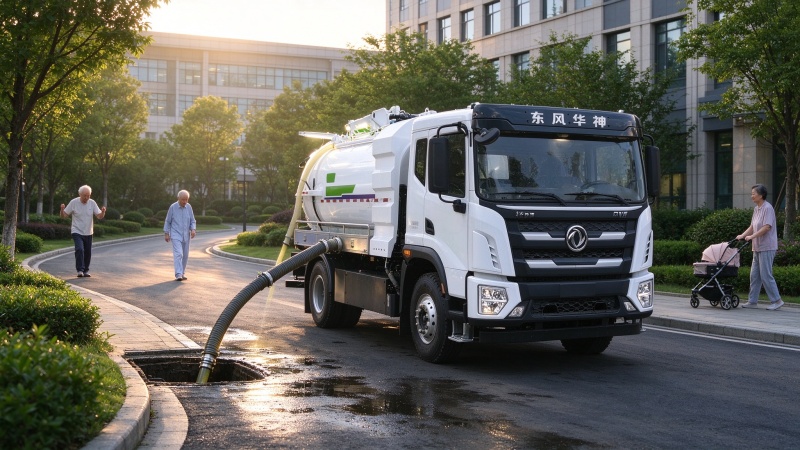
- Urban municipal sanitation — fixed routes, short radius, overnight charging
- Residential and hospital areas — strong demand for low-noise operation
- Low-emission zones — diesel restricted, electric unrestricted
- Fleets with reliable charging infrastructure
Scenarios Requiring Careful Evaluation
- Long-distance cross-district work — over 150 km per day
- Townships without charging facilities — no fixed parking power
- Emergency-response-focused operations — require full charge on standby, uncertain recharge windows
Fleet managers should keep these practical downsides in mind before buying:
Cold weather hits range. Up in northern regions, cold weather can cut the vehicle’s usable driving range by 20 to 30%. Municipal fleets operating in these cold zones need to plan ahead — either schedule shorter working shifts or arrange midday top-ups.
Charging setup costs money. Vehicle cost is just one piece. Site conditions determine how much extra you spend on depot chargers and power upgrades — transformers and 380V power may add 50,000 to 150,000 yuan upfront.
Resale value is not as good. Used electric sanitation vehicles still trail diesel versions. Five-year residual value is lower for now. The difference will get smaller as battery recycling and second-life markets grow.
Battery replacement is costly after warranty expiry. LFP batteries usually have a 5-year / 200,000 km warranty. A full pack change will set you back 80,000–120,000 yuan once the warranty lapses. Most fleets run the vehicle for roughly 8 years and might not need this service. Still, factor this cost into your long-term budget planning.
What’s Next
Whether an electric sewage suction truck is worth buying depends less on product brochures and more on your operating radius, charging infrastructure, and shift scheduling. On paper, the 10.24 m³ tank, 165.68 kWh battery, and 500 kW peak power cover most municipal sewage scenarios. On the balance sheet, annual energy savings of ¥42,000–50,000 pay back the price premium in 3–4 years. The key variable is the fit between your fleet’s charging infrastructure and dispatch flexibility.
Want to calculate the ROI of electric sewage suction trucks for your city or fleet?
Contact our new-energy sanitation vehicle experts today with your operating radius and daily mileage for a customized TCO assessment and configuration recommendation.
