

Is a New Energy Motorhome Worth Buying?
The answer depends on several key factors: the vehicle’s powertrain, real-world range, charging access, interior layout, and total cost of ownership.
Quick Answer: If you usually travel between cities and established campsites and can access compatible charging, a new energy motorhome is worth considering. If you often travel through remote areas, compare the vehicle’s total range, fuel or charging options, and local service support before deciding.
This guide explains what to check before buying and uses the CLW BYD T5DM hybrid motorhome as a real product example. Published specifications don’t match independent road-test results, so confirm the final configuration and test conditions before ordering.

Table of Contents
Choose the Right Powertrain for Your Travel Routes
The best powertrain matches your usual routes and energy infrastructure. A battery-electric motorhome relies on charging, while a plug-in hybrid or range-extended model may combine electric driving with an onboard fuel-powered system.
| Powertrain | How it works | Best questions to ask |
| Battery electric (BEV) | A battery and electric motor provide propulsion. | What is the usable range with the finished motorhome body and normal payload? Which charging connectors and power levels are supported? |
| Plug-in hybrid (PHEV) | The vehicle can charge its battery from an external power source and also uses a fuel-powered engine. The engine’s role varies by system design. | What is the electric-only range? What is the combined range? How does fuel consumption change when the battery is depleted? |
| Range-extended electric | Electric drive propels the vehicle, while an onboard energy source generates electricity to extend travel capability. Exact layouts vary by model. | Does the engine drive the wheels or generate electricity? What are the fuel tank capacity, charging time, and total range under stated test conditions? |
| Conventional diesel or gasoline | A combustion engine provides propulsion. | What are fuel consumption, emissions requirements, service intervals, and local fuel availability? |
Do not assume that “new energy motorhome” means “fully electric.” Ask the supplier to identify the exact system, its operating modes, and what happens when the battery’s state of charge becomes low.
For travelers who stay mainly near cities and developed campsites, a battery-electric model may be practical when charging is available along the route. For longer trips or destinations with limited charging infrastructure, a plug-in hybrid or range-extended configuration may offer more flexibility—but you still need to evaluate its fuel use, electric range, and maintenance requirements.
Understand the Real-World Range You Can Actually Get
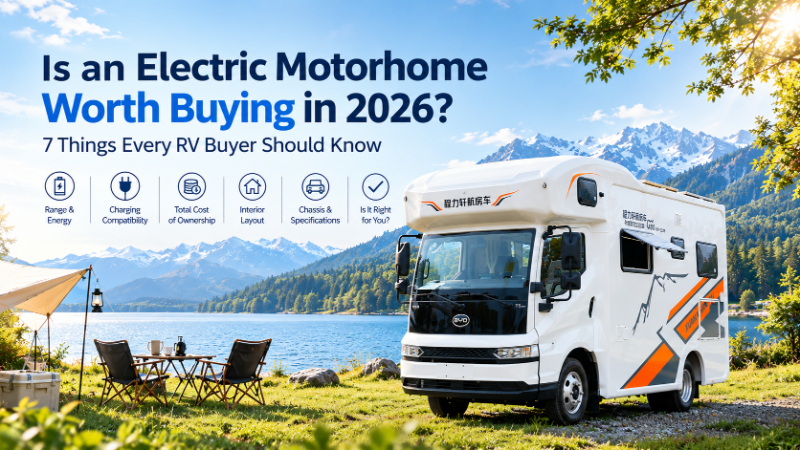
Use the range figure for the exact finished motorhome as a starting point—not as a guarantee of what every journey will deliver. Body construction, passenger and luggage loads, road gradient, speed, weather, climate-control use, and driving style can all affect energy consumption.
Before comparing models, separate these three figures:
- Electric-only range: How far the vehicle can travel using battery energy before the engine or range extender starts, if fitted.
- Combined or total range: The distance possible using the vehicle’s available energy sources under the stated conditions.
- Real-world range: The distance achieved in a particular use case, which should be supported by clearly described test conditions or owner data.
There is no single percentage that reliably converts every motorhome’s advertised range into real-world range. A fully loaded motorhome climbing hills in cold weather may perform very differently from a lightly loaded vehicle travelling at moderate speed in mild conditions. Avoid applying a universal “60–75%” rule unless it is supported by a test relevant to the exact model and use case.
What range information should you request?
Ask the supplier for the rated test-cycle range, battery capacity, usable battery capacity if available, energy consumption, charging time, and test conditions used for any claimed total range. For a hybrid or range-extended model, ask for both electric-only and combined-range information, plus fuel consumption after the battery’s electric driving range has been used.
For example, the BYD T5DM hybrid motorhome lists a 55 kWh BYD Blade Battery, a 1.5T range extender, a 100 L fuel tank, and a claimed total range of up to 1,000 km. This is a published product claim, not an independently verified real-world test result. Buyers should ask CLW to confirm the test standard, operating conditions, and final configuration for the quotation.
Plan a sample journey before you buy. Mark the overnight stops, charging opportunities, fuel stations if relevant, and a contingency option in case a charging point is unavailable. A vehicle that fits your normal itinerary is often more useful than one selected only for the largest advertised range.
Check Charging Compatibility Before You Buy
A charger’s plug, power output, and communication compatibility must match the vehicle. A station being nearby does not automatically mean your motorhome can use it or charge at its advertised maximum rate.
Charging standards and connector types differ by market. For example, China uses national standards including the GB/T 20234 series for conductive charging connectors; Europe commonly uses Type 2 for AC and CCS2 for DC fast charging; and North America includes CCS1 and the SAE J3400 connector, also known as NACS. Actual compatibility depends on the vehicle’s inlet, onboard charging equipment, voltage and current limits, and the charger.
Before ordering, confirm the following in writing:
- AC and DC connector types supported by the vehicle.
- Maximum AC and DC charging power, and the conditions required to reach those rates.
- The expected charging time for the battery configuration being supplied.
- Whether the destination market’s charging network and electrical supply are compatible.
- Whether any adapter is approved by the vehicle manufacturer for that exact vehicle and charger.
- Whether the motorhome can be charged safely at the places where you expect to stay.
A high-power charger does not guarantee that the vehicle will charge at that power throughout the session. Charging speed can depend on the vehicle’s maximum charging rate, battery temperature, state of charge, charger output, and local electrical conditions.
If you are buying for export, confirm charging compatibility for the country where the vehicle will be registered and used, not only the country where it is manufactured. Relevant standards and infrastructure can change, so verify the current local requirements before placing an order.
Compare the Total Cost of Ownership
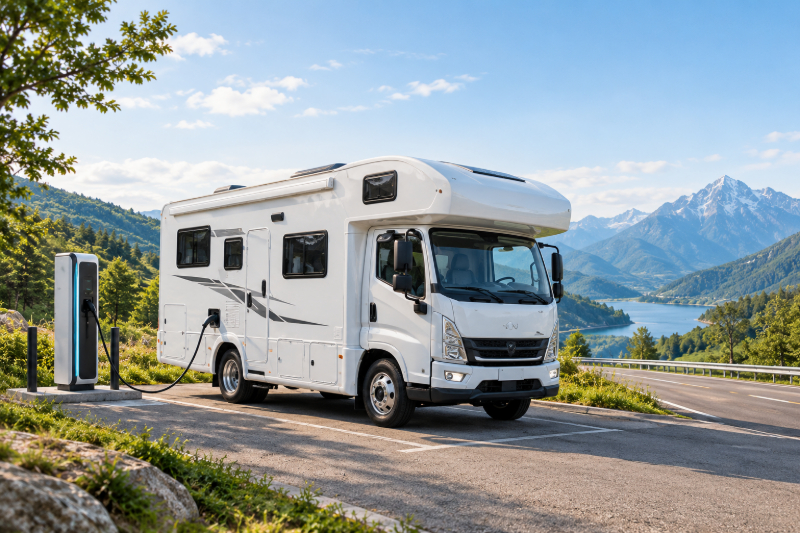
A motorhome is not automatically cheaper than hotels, and an electric powertrain does not automatically mean lower total costs. Compare purchase price, energy, maintenance, overnight stays, insurance, taxes, and expected resale value over the period you plan to own it.
| Cost factor | What to verify | A useful comparison standard |
| Purchase price | Is the quote for the complete vehicle? Are the interior, appliances, taxes, shipping, and optional equipment included? | Compare vehicles with similar layouts, equipment, warranty terms, and delivery scope—not just the chassis price. |
| Electricity or fuel | What are the expected consumption figures and local energy prices? For hybrids, what is fuel consumption when the battery is low? | Estimate energy cost for your typical annual distance using local prices and the vehicle’s stated consumption. |
| Maintenance and repairs | Which service items are required? Are trained technicians and replacement parts available locally? | Request the maintenance schedule, warranty coverage, and service arrangements for the destination country. |
| Campsites and overnight stays | How often will you use paid campsites, hookups, or designated parking? | Estimate the cost per trip and compare it with the accommodation you would otherwise book. |
| Insurance, registration, and taxes | Which vehicle category will apply in the destination market? | Obtain a local estimate based on the finished vehicle’s dimensions, weight, powertrain, and registration class. |
| Resale value | Is there a second-hand market for this type of motorhome and powertrain? | Use comparable local listings or dealer estimates rather than assuming a particular resale percentage. |
A simple way to compare options is to estimate the total cost over your planned ownership period:
Total ownership cost = purchase and delivery costs + energy + maintenance and repairs + insurance and registration + overnight costs − estimated resale value.
Use the same ownership period and travel distance for each vehicle. If you travel only a few days each year, buying an electric motorhome may be harder to justify financially than if you use it regularly. For frequent travellers, the value may also include flexibility, privacy, and having equipment ready to go—not only direct savings.
Choose an Interior Layout That Fits Your Needs
Choose the layout around the people who will travel, sleep, cook, and spend time inside the vehicle. Attractive photographs cannot replace confirmed measurements, payload information, and an equipment list.
1. Sleeping and seating
Confirm the approved passenger capacity, number of sleeping berths, bed dimensions, and whether the layout works for adults and children. Passenger seats and sleeping spaces are not necessarily the same number, so ask for the certified seating capacity and a clear floor plan.
2. Kitchen and dining
Check the cooking equipment, refrigerator capacity, counter space, ventilation, water supply, and dining arrangement. If you plan to cook regularly, make sure the work surfaces and storage are practical for the meals you expect to prepare.
3. Bathroom and water systems
Confirm whether the vehicle includes a toilet, shower, fresh-water tank, grey-water tank, and waste-water system. Ask for tank capacities and how these systems affect available storage and payload.
4. Storage and payload
Look at storage for luggage, clothing, groceries, outdoor equipment, and spare parts. Then confirm the vehicle’s permitted payload after the finished body and fixed equipment are installed. Passengers, water, food, luggage, and optional accessories all add weight.
5. Climate control and onboard power
Ask how heating, air conditioning, refrigeration, cooking appliances, and other equipment are powered. For an electric motorhome, distinguish the traction battery from any auxiliary or house battery. Confirm whether appliances can operate when parked, how long they can run, and whether external power or a generator/range extender is required.
Before ordering a specific vehicle, request its actual floor plan, appliance list, tank capacities, and confirmed dimensions rather than relying on photographs alone.
Check the Chassis and Final Vehicle Specifications
The finished motorhome-not just the original chassis-must meet your requirements for dimensions, weight, range, charging, registration, and serviceability. A recreational body and its equipment can materially change the vehicle compared with a standard commercial chassis.
| Specification | Published product information | What to confirm before ordering |
| Powertrain | 1.5T turbocharged range extender | Exact operating principle, fuel type, and driving modes for the quoted vehicle. |
| Battery | 55 kWh BYD Blade Battery | Whether this is the battery configuration in the final offer and what warranty applies. |
| Fuel tank | 100 L | Final tank specification and applicable market requirements. |
| Claimed total range | Up to 1,000 km | Test standard, test conditions, electric-only range, and expected fuel consumption. |
| Maximum power | 104 kW listed for the range extender | Confirm the technical definition and final specification sheet. |
| Charging power | 95 kW listed | Confirm connector type, supported charging standard, and the conditions under which this rate is achievable. |
| External power output | Up to 6.6 kW listed | Confirm output type, sockets, applicable limits, and which appliances can run simultaneously. |
| Overall dimensions | 5,995 × 2,360 × 3,150 mm | Confirm final body dimensions, mirrors or accessories where relevant, and transport clearance. |
| Gross vehicle weight | 6,495 kg | Confirm the certified gross vehicle weight, curb weight, payload, and registration category. |
| Wheelbase | 3,360 mm | Confirm against the vehicle identification and final approved drawing. |
For a vehicle intended for international use, also confirm the destination country’s requirements for vehicle approval, emissions where applicable, electrical safety, charging compatibility, dimensions, weight, and registration. Ask who is responsible for providing the required documents and whether local after-sales service and spare parts are available.
Decide Whether a New Energy Motorhome Suits You
An electric motorhome is most attractive when its powertrain, range, interior, and support network match your actual travel pattern. It may be a strong candidate for planned routes with reliable charging or for longer-distance travel when the chosen hybrid or range-extended system is suitable for the destination.
It may be less suitable if your regular routes have limited charging or fuel access, if the vehicle’s payload or dimensions do not suit your needs, or if local registration and service support have not been confirmed.
Your pre-purchase checklist
- How many people will travel in the vehicle, and how many approved seats and sleeping berths do you need?
- What is your usual daily distance, and how often will you make longer journeys?
- Will you visit cities and established campsites or travel into remote areas?
- What are the electric-only range and total range of the exact configuration?
- Which charging connectors and charging power are supported in your destination market?
- What are the vehicle’s final dimensions, gross vehicle weight, and usable payload?
- Which kitchen, bathroom, climate-control, storage, and external-power features are included?
- What is included in the quotation, warranty, delivery scope, and after-sales support?
- Can the vehicle be registered and operated legally in your country?
If you cannot yet answer these questions, request a detailed specification sheet and a layout drawing before comparing prices. A well-matched vehicle is more valuable than a longer list of features that do not fit your intended use.
Conclusion: Is a New Energy Motorhome Worth Buying?
The CLW BYD T5DM hybrid motorhome is one option for buyers looking for a motorhome with a range-extender system, onboard living facilities, and external power capability. Its published specification includes a 55 kWh battery, a 1.5T range extender, a 100 L fuel tank, and up to 6.6 kW of external power output. Final equipment and specifications should be confirmed for the exact vehicle and target market.
Looking for a reliable new energy motorhome for your next adventure? Contact Chengli today to discuss your requirements with our professional team and explore customized motorhome solutions tailored to your travel needs and target market.
