

Buying an ambulance for Africa from China raises three common worries for African buyers:
Will it suit our roads and local rules? Can we trust the supplier? Who will fix it when something breaks?
A low price alone is never enough. The right answer depends on your market, your roads, and the kind of calls you handle.
This guide walks you through four practical steps to choose a Chinese ambulance that actually works in Africa — chassis and steering side, medical level, supplier checks, and delivery with the correct documents. You also get a quick country guide for Nigeria, Kenya, Ghana and Zimbabwe.
Key Takeaways
- Match steering side and chassis to what local workshops already know how to service.
- Choose medical level according to the patients you actually move — most operators do not need full ICU.
- Verify the supplier with written configuration lists, power confirmation, and inspection records.
- Plan shipping terms (FOB or CIF) and country-specific documents early with your clearing agent. Missing mandatory certificates is the most common reason vehicles get delayed or held at port.
Why Consider a Chinese Ambulance for Africa?
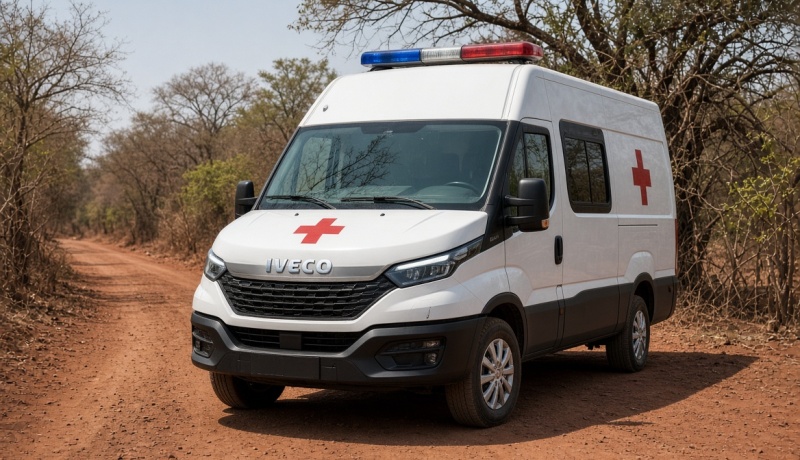
A well-chosen Chinese ambulance offers four clear advantages for African buyers:
- Wide chassis choice
Builders work with Dongfeng, Iveco, Ford, Foton, Isuzu, Mercedes-Benz, Toyota, SAIC Maxus, JMC and Geely. You can select a chassis that local workshops already understand.
- Built to your requirements
Cabin layout, medical equipment, colours, logo, and painting can all be customised (OEM).
- Low entry barrier
Minimum order is usually one unit. Lead time typically ranges from 15 to 60 days, depending on the chassis.
- Flexible shipping
FOB and CIF terms are commonly available. EXW and DDP are rarely offered for this type of vehicle.
These benefits only materialise when the four steps below are followed carefully.
How to Choose a Chinese Ambulance for Your Market?
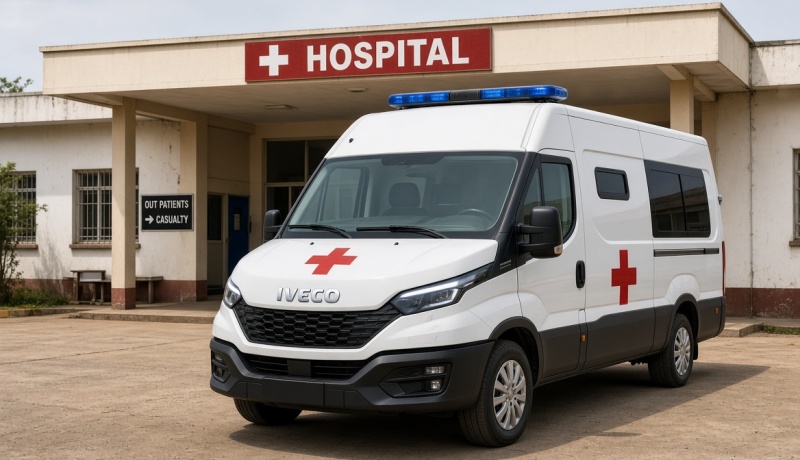
Step 1: Match Chassis and Steering Side to Your Country
Check the steering side first
- Right-hand drive is required in countries that drive on the left (Kenya, Zimbabwe).
Our current RHD options include Iveco and Foton. Confirm availability for other preferred chassis with the supplier. - Left-hand drive is standard in countries that drive on the right (Nigeria, Ghana).
Choose a chassis your workshops can actually service
- Ask local garages which brands they already work on regularly.
- Request a spare-parts list (with typical lead times for critical items) together with the quotation.
- Need 4×4 for rural or rough roads? It is available on Iveco, Ford, Dongfeng and SAIC Maxus.
Step 2: Match Medical Level to the Calls You Handle
- Transfer – Moves stable patients between home, clinic and hospital. Lowest cost.
- Monitoring – Handles emergency pickup. Equipped with a ventilator, defibrillator and suction unit. Mid-range cost.
- ICU – Moves critically ill patients between hospitals. Highest cost and most complex equipment.
Rule of thumb: If the majority of your work involves stable patients, full ICU specification is usually unnecessary and adds unnecessary cost and power demand.
Confirm in writing that the cabin electrical system can support the equipment you plan to install.
Step 3: Check the Supplier Before You Pay
A Chinese ambulance is only as reliable as the company that builds and ships it. Verify these points:
- Company background: website, physical address, social media presence and previous export projects to Africa.
- Written configuration list: every item included and every optional item clearly stated in the quotation.
- Equipment power confirmation: the supplier must confirm in writing that the cabin can carry and power your chosen medical equipment.
- Inspection process: ask what tests every vehicle undergoes. Reputable builders typically perform electrical system testing, water-leakage testing and a road test. Third-party pre-shipment inspection (SGS, BV or equivalent) is recommended.
- Corrosion protection: box-type bodies usually receive electrophoresis treatment; van-type bodies often receive full-vehicle wax protection — both help during ocean freight and long-term use in humid or dusty conditions.
- Warranty in the contract: typically 3 years or 50,000 km on the chassis and 1 year on the medical body and conversion.
Always request photos or video of your specific vehicle before it ships. Factories holding ISO 9001 and with documented export records to African markets provide stronger trust signals.
Step 4: Plan Delivery and Documents Early
Shipping
- FOB and CIF are the most common terms.
- Landlocked countries (for example, Zimbabwe) need the road leg from the seaport planned.
Documents – Country-Specific Requirements
Reputable suppliers provide technical documentation, but final compliance is the buyer’s responsibility. Rules change, so always confirm the latest requirements with your clearing agent before ordering.
- Nigeria: SONCAP (Standards Organisation of Nigeria Conformity Assessment Programme) is mandatory for motor vehicles, including ambulances. Product Certificate + SONCAP Certificate are required for Form M and customs clearance. Medical equipment may also need NAFDAC registration.
- Kenya: Used and special-purpose vehicles (including ambulances) generally require a Certificate of Roadworthiness (CoR) issued through the KEBS-appointed channel (QISJ). This is distinct from the general-goods PVoC process. Age waivers for special-purpose vehicles are possible under strict conditions — apply before shipping.
- Ghana: Vehicles fall under the GSA EASYPASS / PVoC framework. Pre-export verification of conformity for imported vehicles became fully mandatory from 1 October 2026. Compliance certificates must be obtained in the country of export.
- Zimbabwe: Right-hand drive is compulsory. Medical vehicles typically require Ministry of Health-related approvals, SAZ technical compliance, and ZIMRA customs procedures. Import permits may also apply. Plan both documentation and the inland transport leg early.
Common supporting documents across markets include commercial invoice, packing list, bill of lading, certificate of origin and full technical specifications.
Country Quick Guide
| Country | Steering side | What to check first |
|---|---|---|
| Nigeria | Left-hand drive | Chassis local workshops can service; spare parts; SONCAP (and NAFDAC if applicable) |
| Kenya | Right-hand drive | RHD availability; 4×4 for rural roads; CoR via QISJ; special-purpose age waiver if needed |
| Ghana | Left-hand drive | Medical level matching actual calls; chassis with local parts network; GSA EASYPASS / PVoC (mandatory from Oct 2026) |
| Zimbabwe | Right-hand drive | RHD compulsory; Ministry of Health / SAZ compliance; inland transport from port; spare-parts support |
Use this table only as a starting point. Always confirm current requirements with your clearing agent.
Questions Buyers Should Confirm Before Ordering
- What will the ambulance mainly do — transfer, emergency response, or ICU transport?
- Does your country require left-hand or right-hand drive?
- Which chassis brands can your local workshops already service?
- What kind of roads will it face? Do you need 4×4?
- Which medical equipment must the cabin carry and power?
- Has the supplier confirmed cabin electrical capacity in writing?
- How many vehicles do you need and by what date?
- Which port will receive the shipment? Do you prefer FOB or CIF?
- Which mandatory certificates (SONCAP, CoR, EASYPASS/PVoC, etc.) does your country require?
- Do you need OEM branding or special painting?
What’s Next?
The right Chinese ambulance matches your country’s driving side, your local workshops, your roads, the patients you actually move, and the mandatory certification path — not just the lowest price.
Start with steering side and chassis. Then verify the supplier, confirm the medical level and power requirements, lock in the correct certificates with your clearing agent, and finalise shipping terms.
Ready to move forward?
Contact us with your country, preferred chassis, medical level and any special requirements. We will prepare a clear configuration list, confirm available steering and 4×4 options, and provide the technical documents needed to support your local certification process.
Frequently Asked Questions
Are Chinese ambulances good quality?
Quality depends on the supplier, the chassis and the inspection. Check the five points in Step 3 before you pay. Ask for a written configuration list and photos of your build.
Which chassis can I choose?
Dongfeng, Iveco, Ford, Foton, Isuzu, Mercedes-Benz, Toyota, SAIC Maxus, JMC and Geely. Pick one that your local workshops can service.
Can I get a right-hand drive ambulance for Kenya or Zimbabwe?
Yes. Right-hand drive is available on Iveco and Foton. Tell us your country, and we will confirm the setup.
Can I order one ambulance? How long does it take?
Yes. The minimum order is one unit. Lead time is usually 15 to 60 days, depending on the chassis.
Which documents do you provide?
We can supply CoC, PVoC and related documents. Ask your clearing agent what your country needs.
Which shipping terms and warranty do you offer?
FOB and CIF where needed. We do not offer EXW or DDP. The chassis has a 3-year or 50,000 km warranty. The medical body has a 1-year warranty.
Can I add my own logo and colours?
Yes. Chinese ambulances for Africa are available for OEM logos, painting, and branding.
