

Edible oil is transported in large quantities from oil processing plants to storage facilities, food manufacturers, and distribution centers. For these deliveries, an edible oil tanker truck provides a practical way to move bulk liquids over long distances.
Not every edible oil has the same transportation requirements. Soybean and sunflower oil generally remain liquid under normal conditions, while palm oil and certain animal fats can become thick or solidify when temperatures drop. This difference affects the tank material, insulation, heating equipment, and unloading system.
Understanding these requirements before ordering a tanker can help avoid unnecessary equipment costs and problems during actual operation. Here are seven important features worth looking at.
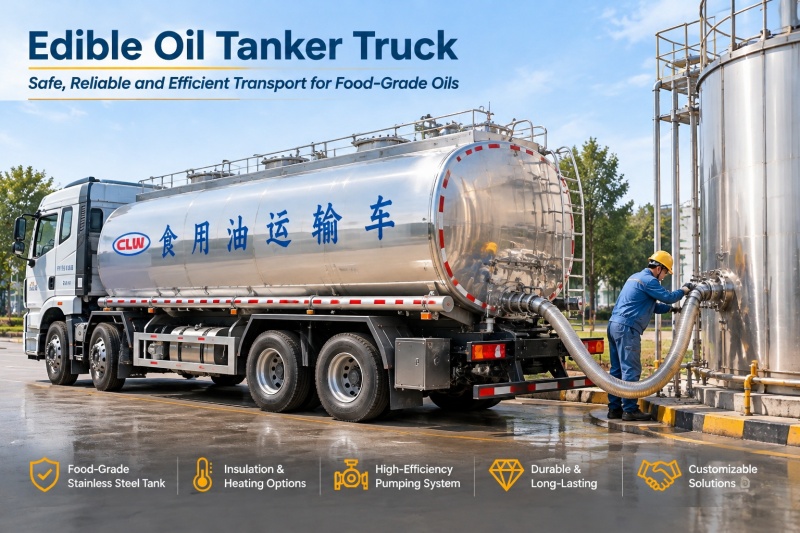
Table of Contents
Different Oils Require Different Edible Oil Tanker Truck Configurations
The type of oil being transported has a direct influence on the tanker design. A configuration suitable for ordinary vegetable oil may not work as well for palm oil or animal fats.
Here are some common transportation materials and their requirements:
| Oil Type | Transportation Characteristics | Typical Requirements |
|---|---|---|
| Soybean Oil | Usually remains liquid under normal conditions | Food-contact-compatible tank and standard discharge system |
| Sunflower Oil | Generally easy to handle in liquid form | Clean tank interior and suitable transfer pump |
| Palm Oil | Can become cloudy or solidify at lower temperatures | Insulation and heating may be required |
| Animal Fats / Tallow | Some types have relatively high melting points | Temperature control and suitable pumping equipment |
For vegetable oils that remain liquid during transportation, a conventional insulated or non-insulated tanker may be sufficient, depending on the climate and operating conditions.
Palm oil and certain animal fats require more attention. If the product cools too much, it may become difficult to pump through the discharge pipeline. In these cases, heating coils and thermal insulation can help maintain a suitable temperature.
The final configuration should always be matched to the specific product rather than selected solely by tank capacity.
Stainless Steel Is a Common Choice for Edible Oil Tanker Truck Tanks
Stainless steel is widely used in food-related tanker applications because it is durable, corrosion-resistant, and relatively easy to clean.
Two commonly considered grades are SS304 and SS316.
SS304 Stainless Steel
- Suitable for many common edible oil transportation applications.
- Offers good corrosion resistance.
- Widely used in food-processing and liquid transportation equipment.
- Provides a practical balance between performance and cost.
SS316 Stainless Steel
- Contains molybdenum, which improves resistance to certain corrosive environments.
- May be preferred when the transported product or cleaning conditions require additional corrosion resistance.
- Generally costs more than SS304.
For most ordinary edible oil applications, SS304 may be sufficient. SS316 should be considered when the product characteristics or applicable requirements justify it.
The internal finish is also worth checking. Smooth surfaces, properly designed welds, and accessible inspection openings make cleaning easier and help reduce oil residue after unloading.
Edible Oil Tanker Truck Capacity Must Match the Vehicle’s Payload
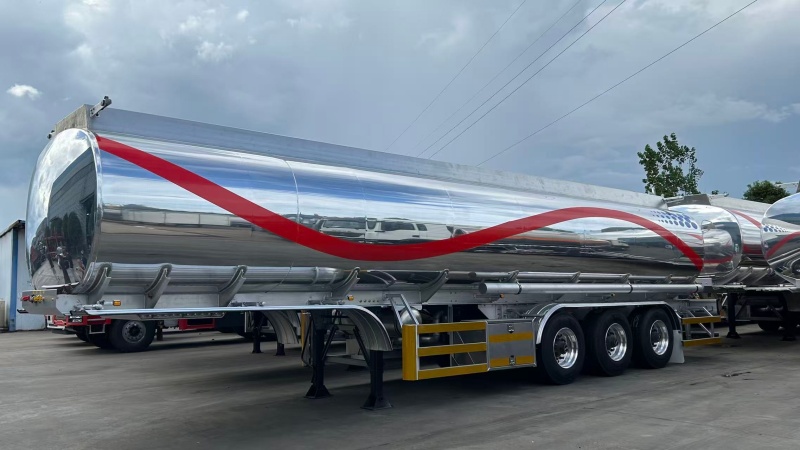
A larger tank does not automatically mean a more efficient tanker. The actual loading weight must be considered alongside the nominal tank volume.
Edible oils have different densities, so the same tank volume can result in different payload weights.
For preliminary planning, the following approximate values can be used:
| Product | Approximate Density |
|---|---|
| Soybean Oil | 0.92 kg/L |
| Palm Oil | 0.89–0.92 kg/L |
| Animal Fats | Varies by product and temperature |
These are indicative figures, not fixed design values. The actual density should be confirmed using the product supplier’s data at the relevant loading temperature.
Example: 25,000-L Edible Oil Tanker
Assuming an oil density of 0.92 kg/L:
25,000 L × 0.92 kg/L = 23,000 kg
This means the oil itself weighs approximately 23 tonnes. The weight of the tanker body, chassis, fuel, equipment, and other components must also be included.
Before finalizing the tank volume, check:
- Maximum permitted gross vehicle weight.
- Individual axle load limits.
- Chassis payload capacity.
- Tank dimensions and weight distribution.
- Local road restrictions in the destination country.
Tank capacity and chassis specifications should be calculated together. This is particularly important for large-capacity 6×4 and 8×4 tankers.
Heating and Insulation for Temperature-Sensitive Oils
Heating is not necessary for every edible oil tanker. For products that remain liquid throughout transportation, a conventional tank may be sufficient. For an edible oil tanker truck designed to transport temperature-sensitive products, the right combination of heating and insulation can make a significant difference in unloading efficiency.
However, palm oil, tallow, and certain other fats may need additional temperature control, particularly during transportation in colder climates.
Tank Insulation
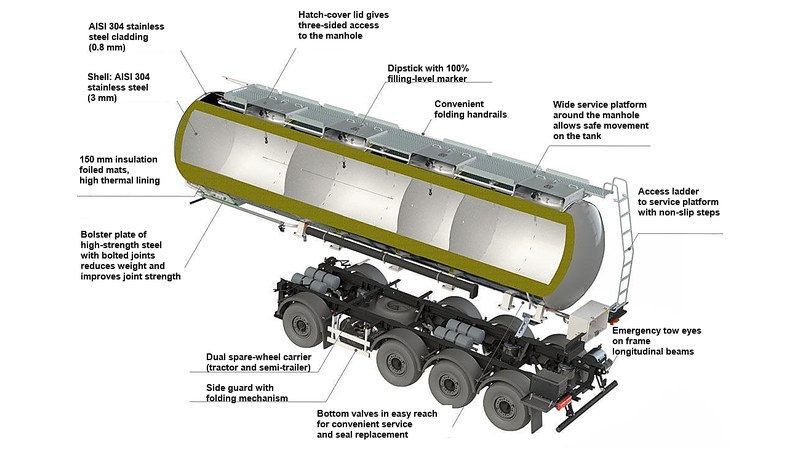
An insulated tank helps slow down heat loss during transportation.
Common insulation materials include polyurethane foam and other suitable thermal insulation materials, usually protected by an external metal covering.
Insulation does not produce heat by itself. Its purpose is to help the product retain its temperature for longer.
Heating Coils
Heating coils can be installed inside the tank to warm the transported product.
Depending on the tanker design and available heating source, common heating media include:
- Hot Water: Provides relatively gentle heating and can help reduce the risk of localized overheating.
- Low-Pressure Steam: Can provide a higher heat-transfer rate, but temperature and pressure need to be properly controlled.
The heating system should be designed according to the product’s melting point, required unloading temperature, and tank capacity.
Heating Time and Temperature Control
There is no universal heating time for all edible oil tankers. The actual time depends on:
- Initial oil temperature.
- Required unloading temperature.
- Tank capacity and oil volume.
- Heating medium and heating power.
- Insulation performance.
- Ambient temperature.
For this reason, heating capacity should be calculated according to the intended operating conditions.
Temperature monitoring is also useful during heating and unloading. Excessive localized heating may affect product quality, so the heating arrangement should distribute heat as evenly as practical.
Pumps and Discharge Equipment Affect Unloading Efficiency
The unloading system should be selected according to the oil’s viscosity and the receiving facility’s requirements.
Different pumps are suitable for different operating conditions.
1. Centrifugal Pumps
These are commonly used for relatively low-viscosity liquids. They can provide a practical solution for many vegetable oil transportation applications.
2. Positive-Displacement Pumps
Gear pumps and other positive-displacement designs may be more suitable for higher-viscosity oils and fats. They can move thicker liquids more effectively when properly selected for the operating conditions.
Other important components include:
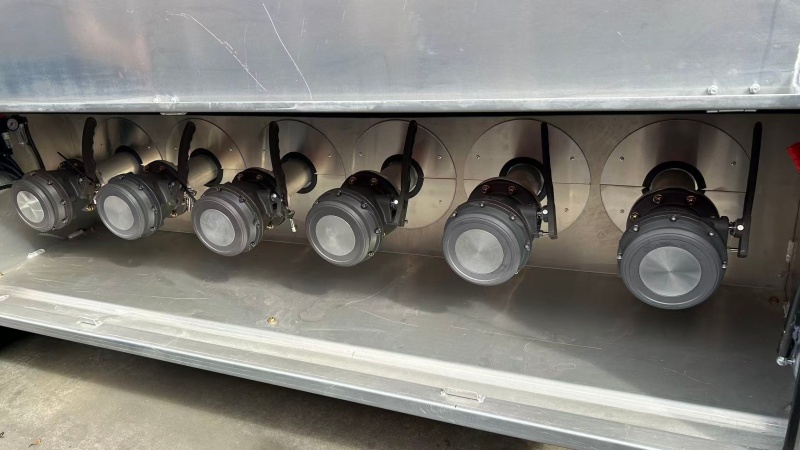
- Discharge Pipelines: Pipe diameter should match the required flow rate and product viscosity.
- Valves: Used to control product flow and isolate discharge lines.
- Flexible Hoses: Connect the tanker to storage tanks or processing equipment.
- Pump Connections: Should be arranged for convenient operation and maintenance.
The unloading system should also be easy to drain and clean. Oil left inside pipelines and hoses can become difficult to remove, especially when transporting products that thicken as they cool.
Chassis Configuration and Vehicle Performance
The chassis supports the tank and its contents. Its load capacity, axle arrangement, and frame dimensions must match the intended transportation application. When choosing an edible oil tanker truck, chassis selection should be based on the total loaded weight, transportation distance, and local road conditions.
Common chassis configurations include:
1. 4×2 Chassis
Generally used for smaller tankers and lighter-duty transportation. It can be suitable where loading requirements and local weight limits allow.
2. 6×4 Chassis
A common option for medium- and heavy-duty transportation. It offers a balance between load capacity and operating flexibility.
3. 8×4 Chassis
Often considered for larger-capacity tankers where additional axle capacity is needed.
Apart from the drive configuration, buyers should pay attention to the following:
- Engine power and torque.
- Transmission type and axle ratios.
- Gross vehicle weight rating.
- Individual axle load ratings.
- Wheelbase and frame dimensions.
- Tire load capacity.
- Emission standards in the destination country.
The tank must be positioned and secured according to the chassis design. Weight distribution is particularly important because uneven loading can affect handling, braking, and vehicle stability.
A suitable chassis should be selected according to the actual loaded weight, not simply the advertised tank volume. This is important because uneven loading can affect handling, braking, and vehicle stability.
Cleaning, Food Safety, and Routine Maintenance
Cleaning is one of the most important considerations in edible oil transportation, especially when a tanker is used for different products.
Oil residue left inside the tank, pipelines, valves, or hoses can affect the next load. This becomes more complicated when switching between different vegetable oils or transporting animal fats.
A suitable tanker design should provide:
- Accessible manholes and inspection openings.
- Smooth internal surfaces that are easier to clean.
- Properly designed discharge pipelines with minimal product retention.
- Food-contact-compatible valves, seals, hoses, and fittings.
- Drainage arrangements that help remove remaining liquid.
For operators handling different types of oil, a documented cleaning procedure should be followed between loads.
Depending on the equipment and operation, cleaning-in-place (CIP) arrangements may also be considered. These systems allow internal cleaning through dedicated spray devices and circulation equipment without requiring extensive manual access.
Food-Contact Requirements and Regulations
The requirements for food-contact materials vary between destination markets. Buyers should confirm the applicable standards for the tank’s internal surfaces, seals, hoses, valves, and other product-contact components.
For example, certain markets may require compliance with FDA food-contact requirements or relevant EU food-contact material regulations.
Other requirements may include:
- Vehicle registration and tanker construction standards.
- Pressure and vacuum protection requirements, where applicable.
- Maximum gross vehicle weight and axle load limits.
- Local road transportation and safety regulations.
These requirements should be checked before production, especially for export orders. These details provide a much clearer basis for preparing a suitable vehicle specification.
Common Configuration Mistakes to Avoid
Even when the basic tanker specifications look suitable, several details can easily be overlooked during purchasing.
- Choosing tank capacity without checking payload
A 25,000-L tank may sound suitable, but the actual loaded weight could exceed the vehicle’s permitted gross weight or axle limits.
- Ordering heating without checking heating capacity
Installing heating coils does not automatically guarantee efficient heating. The heating source, power, coil arrangement, and insulation should all match the transported product.
- Selecting a pump based only on flow rate
Oil viscosity and operating temperature also affect pump performance. A pump suitable for soybean oil may not be the best choice for cold palm oil or animal fats.
- Ignoring cleaning requirements
The tank, valves, hoses, and pipelines all need to be considered as part of the product-contact system. Overlooking cleaning access can create problems when changing between different loads.
Conclusion
An edible oil tanker truck needs to be designed around the product it carries. A tanker for soybean oil may not require the same heating equipment as one transporting palm oil or animal fats. Tank material, capacity, chassis configuration, and unloading equipment should all work together.
Looking for an edible oil tanker truck for your business? Contact us to discuss your requirements. Tell us what type of oil you transport, your required tank capacity, and the destination country. Our team can help you review the vehicle configuration and prepare a quotation based on your transportation and operating conditions.
Frequently Asked Questions
What types of oil can an edible oil tanker truck transport?
Edible oil tanker trucks are commonly used to transport soybean oil, sunflower oil, palm oil, rapeseed oil, and other vegetable oils. With the appropriate tank and heating configuration, they can also transport certain animal fats and tallow.
Is stainless steel 304 suitable for edible oil transportation?
Yes. SS304 stainless steel is widely used for edible oil transportation because of its corrosion resistance, durability, and ease of cleaning. SS316 may be considered when the transported product or cleaning conditions require additional corrosion resistance.
Does an edible oil tanker truck need a heating system?
Not always. Many vegetable oils can be transported without additional heating under suitable temperature conditions. However, palm oil and certain animal fats may become thick or solidify at lower temperatures. In these cases, an insulated tank and heating system can help maintain the required temperature for unloading.
What is the difference between an insulated tanker and a heated tanker?
An insulated tanker has a thermal insulation layer that slows down heat loss. A heated tanker is equipped with a heating system, such as internal heating coils, to supply heat to the transported product. Some tankers combine both systems, especially when transporting temperature-sensitive oils and fats.
