

Fuel transportation isn’t just about moving diesel from one location to another. For fuel distributors, fleet operators, and industrial suppliers in Guatemala, the right fuel tanker truck must balance loading capacity, road conditions, vehicle weight, delivery efficiency, and local compliance requirements.
A truck that carries a large volume on paper may not be able to transport the same volume legally under its actual payload limit. A configuration that works on flat highways may need adjustment for hilly roads, narrow access routes, or frequent urban deliveries.
This guide explains how to evaluate a 15,000L fuel transport truck for the Guatemalan market, including its structure, technical specifications, loading capacity, pumping system, safety equipment, and customization options.
Table of Contents
Why Consider a 15,000L Fuel Tanker Truck?
A 15,000L fuel tanker truck can be a practical option for operators who need a balance between delivery volume and vehicle maneuverability.
Compared with smaller tankers, a 15,000L model can transport more fuel per trip, potentially reducing the number of deliveries required for a regular distribution route. Compared with much larger tankers, it may be easier to adapt to operations involving regional fuel stations, industrial customers, and locations with more restricted access.
However, the right capacity depends on the actual delivery task.
Before selecting a tanker, consider:
- How much diesel is required at each delivery point?
- How far is the route between the fuel depot and the customer?
- Will the truck mainly travel on highways, urban roads, or rural roads?
- Are there steep gradients, narrow roads, or difficult turning areas?
- What are the vehicle’s legal gross weight and axle-load limits?
The 15,000L figure describes the nominal tank capacity. It does not automatically mean that the vehicle can legally carry 15,000L of diesel on every trip. Actual loading must be calculated according to the truck’s rated payload, fuel density, axle ratings, and applicable local requirements.
Guatemala’s Fuel Transportation Market and Key Applications
Guatemala relies on imported petroleum products to supply its domestic market. According to the Ministry of Energy and Mines (MEM), diesel imports reached approximately 17.34 million barrels in 2025, making diesel the largest of the main fuel categories. This sustained import volume creates ongoing demand for fuel storage, distribution, and reliable transportation between supply terminals and end users.
For operators running a 15,000L fuel tanker truck, the key question is not simply whether the tank is large enough. It is whether the vehicle can complete the intended delivery route safely and economically. The right configuration should match the actual application rather than adding every available accessory.
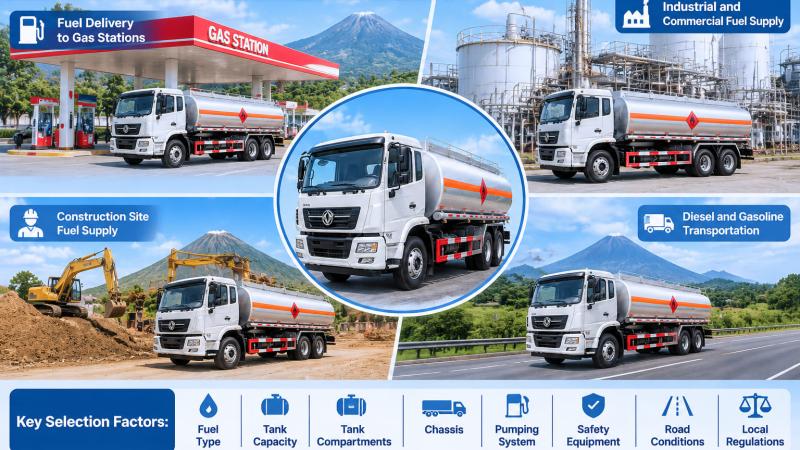
- Gas station fuel supply
Fuel distributors regularly move diesel and gasoline from terminals or storage facilities to service stations. Priority factors usually include compartment arrangement, accurate fuel measurement, suitable unloading connections, and efficient hose handling.
- Industrial and commercial fuel delivery
Factories, warehouses, and commercial facilities often need scheduled diesel deliveries for generators, machinery, or operational vehicles. Pump capacity, hose length, outlet position, and connection compatibility with the receiving facility should be confirmed in advance.
- Construction site fuel supply
Construction projects frequently operate on uneven access roads with limited turning space and changing unloading locations. Chassis suitability, ground clearance, approach angles, and vehicle stability during unloading become especially important.
- Agricultural fuel supply
Agricultural operations often require diesel deliveries to machinery or storage tanks in rural areas. Route conditions, delivery frequency, and distance from the nearest supply point influence whether a 15,000L capacity is the most practical choice.
These are the main application scenarios in Guatemala. The final vehicle configuration should always be based on the operator’s actual routes, delivery process, and local operating conditions.
How Does a 15,000L Fuel Tanker Truck Work?
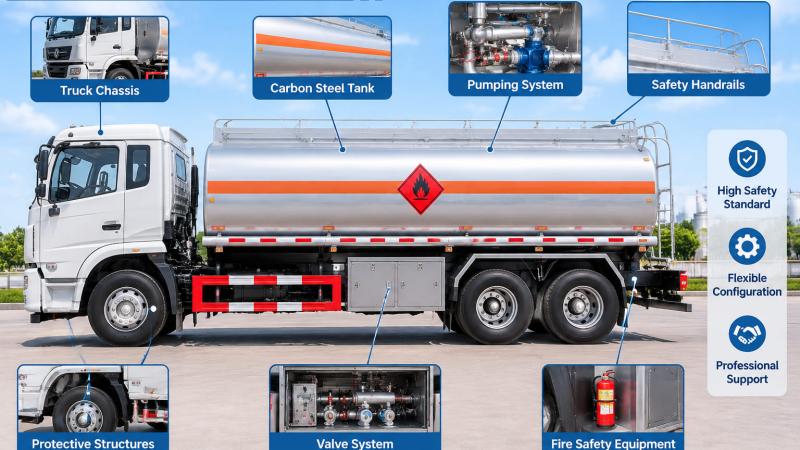
A Fuel Transport Truck generally consists of two main parts: the truck chassis and the tanker superstructure.
The chassis provides the engine, transmission, axles, suspension, braking system, and supporting frame. The superstructure includes the tank body, loading and unloading equipment, pipelines, valves, and safety accessories.
A typical fuel delivery process includes:
- Loading: Diesel enters the tank through the designated loading connection at the supply facility.
- Transportation: The tank carries the fuel to the delivery location. Internal partitions, where fitted, help reduce liquid movement during driving.
- Unloading: Fuel is discharged through the specified outlet and piping arrangement. Depending on the configuration, unloading may use a pump or gravity flow.
- Measurement: A flow meter or fuel dispenser can be installed as an optional configuration to measure the delivered quantity.
The power take-off (PTO) transfers power from the vehicle transmission to the fuel pump through the appropriate drive arrangement. When the pump is engaged, it provides the pressure and flow required for the configured loading or unloading operation.
The actual pump type, pipeline layout, valve arrangement, and operating method should be selected according to the customer’s terminal and delivery requirements. These selections must also consider the density, legal payload, and permitted vehicle weight in the destination market.
15,000L Fuel Tanker Truck Specifications
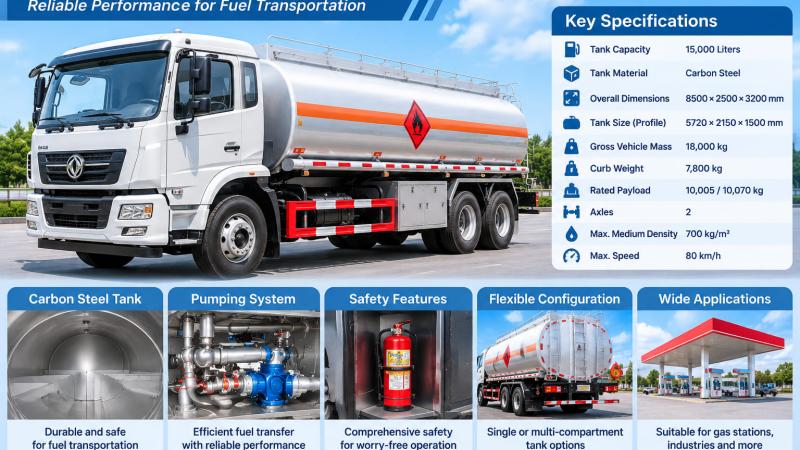
The following table summarizes the published specifications of CLW’s 15,000L fuel transport truck.
| Item | Published Specification |
|---|---|
| Nominal tank capacity | 15,000L |
| Tank material | Carbon steel |
| Overall dimensions | 8,500 × 2,500 × 3,200 mm |
| Gross vehicle weight (GVW) | 18,000kg |
| Curb weight | 7,800kg |
| Rated payload | 10,005 / 10,070kg |
| Axle configuration | 2 axles |
| Maximum speed | 80km/h |
| Engine options | Weichai WP7H series / SINOTRUK MC07 series |
These are alternative engine options, not equipment fitted simultaneously to one truck. Final availability and compatibility must be confirmed with the selected chassis configuration.
The published dimensions and weights should also be checked against the final vehicle drawing and chassis specification before ordering.
Single-Compartment vs. Multi-Compartment Fuel Tankers
Tank compartment design affects how a fuel tanker is used.
Single-compartment tank
A single-compartment tank is suitable when the vehicle transports one type of fuel and normally delivers the full load to one destination or through one unloading operation.
Its structure is comparatively straightforward, but it offers less flexibility when a delivery route includes multiple customers.
Multi-compartment tank
A multi-compartment tanker divides the tank into separate sections using internal partitions. This allows the operator to carry separate batches of the same fuel and unload them at different locations.
Potential advantages include:
- Delivering different quantities to multiple customers.
- Managing separate delivery batches.
- Reducing the need to return to the depot between every delivery.
- Improving flexibility for scheduled distribution routes.
For a diesel-only operation, multiple compartments can still be useful because different customers may require different delivery quantities.
The number of compartments and the capacity of each section should be determined according to the delivery schedule, unloading equipment, and tank design. For example, a three-compartment arrangement may be considered, but the final division should be confirmed with the manufacturer and operator.
How Much Diesel Can a 15,000L Tanker Actually Carry?
Tank volume and legal payload are two different measurements.
A 15,000L tank has a nominal volume of 15 cubic metres. Diesel density varies with fuel grade and temperature. For an illustrative calculation, a density range of approximately 0.82–0.86kg/L can be used.
| Calculation | Result |
|---|---|
| Nominal tank volume | 15,000L |
| Illustrative diesel density | 0.82–0.86kg/L |
| Fuel mass at 0.82kg/L | 12,300kg |
| Fuel mass at 0.86kg/L | 12,900kg |
This means that 15,000L of diesel could weigh approximately 12.3–12.9 tonnes under these illustrative density assumptions.
However, the published rated payload of the CLW vehicle is approximately 10,005–10,070kg. Therefore, the vehicle’s rated payload may be reached before the nominal tank volume is filled.
The actual permitted loading volume must be calculated using:
- The actual density of the diesel being transported.
- The vehicle’s certified rated payload and gross vehicle weight.
- Front and rear axle load ratings.
- Tank design and required filling allowance.
- Applicable local transport and operating regulations.
For this reason, operators should not assume that a 15,000L tank can always be filled to its nominal capacity with diesel. The final loading limit must be confirmed for the specific vehicle and operating conditions.
Unit conversion: 15,000L is approximately 3,962 US gallons.
How to Choose the Right Fuel Tanker Truck in Guatemala?
Selecting a fuel tanker involves more than choosing a tank capacity. The chassis, tank structure, pumping system, and safety equipment must work together.
1. Match the chassis to the route
Consider the total vehicle weight, axle ratings, engine performance, transmission, suspension, braking system, and road conditions.
Guatemala has a combination of urban roads, highways, rural routes, and mountainous sections. Narrow roads, steep gradients, traffic, and rainy-season conditions may affect vehicle selection. Operators should assess their actual routes before confirming the chassis and axle configuration.
2. Select the tank structure
The tank material, thickness, internal partitions, manholes, baffles, and protective structures should be specified according to the intended service and applicable technical requirements.
3. Choose the appropriate pump and unloading system
The pump should be matched to the required flow rate, unloading distance, fuel type, and receiving equipment. Confirm whether the customer needs pump-assisted unloading, gravity unloading, or both.
4. Confirm the measurement equipment
A flow meter or fuel dispenser may be required for delivery operations. Its accuracy, calibration documentation, and suitability for the intended commercial use should be checked with the relevant local authorities and customer.
5. Specify the safety equipment
Depending on the final design and applicable requirements, the tanker may include emergency shut-off devices, valves, fire extinguishers, static grounding equipment, warning signs, and other protective accessories.
The final configuration should be reviewed against the intended operating environment and local requirements.
Guatemala Compliance: What Should Operators Check?
Before purchasing or putting a fuel tanker into service in Guatemala, operators should verify the applicable requirements with the relevant authorities.
The Ministry of Energy and Mines (MEM), through its General Directorate of Hydrocarbons, publishes procedures for a transport licence covering petroleum and petroleum products transported by mobile units.
The official procedure information identifies documents and checks that may include:
- The transport licence application and vehicle identification forms.
- Vehicle registration documentation.
- Proof of ownership or an applicable lease agreement.
- A calibration certificate issued by an authorized entity, where applicable.
- A certificate of functionality issued by an authorized entity.
- A valid transport insurance policy.
The applicable insurance coverage and safety requirements should be checked against the current rules and the specific transport operation.
Operators should also confirm the requirements for vehicle registration, technical inspection, fuel loading and unloading connections, flow-meter calibration, warning signs, and safety equipment.
Important: A manufacturer’s standard equipment list or a certificate issued in another country does not automatically establish compliance with Guatemalan requirements. Before production is finalized, the buyer should confirm the applicable MEM procedures and any additional requirements for the intended fuel terminal and operating area.
Why Choose CLW for a Customized Fuel Tanker Truck?
A fuel tanker should be configured around the operator’s delivery process, not selected only by its nominal tank capacity.
CLW provides customized special-purpose vehicle solutions based on the customer’s chassis selection, tank capacity, fuel type, and equipment requirements.
Depending on the project, the configuration can be discussed in the following areas:
- Tank structure: Capacity, material, compartment arrangement, and tank dimensions.
- Chassis selection: Brand, drive configuration, engine, axle ratings, and vehicle dimensions.
- Pumping system: Pump type, flow rate, PTO arrangement, pipelines, and valves.
- Delivery equipment: Flow meter, hose reel, fuel dispenser, and unloading connections.
- Safety equipment: Emergency shut-off devices, fire extinguishers, static grounding equipment, warning signs, and other specified accessories.
The final configuration is subject to technical review, chassis compatibility, and applicable destination-market requirements.
For customers in Guatemala, discussing the actual delivery route and unloading facilities before production can help avoid unnecessary equipment and improve the suitability of the finished vehicle.
Frequently Asked Questions and Request a Quote
Q1: Is 15,000L equal to 3,962 gallons?
Approximately. 15,000 litres is about 3,962 US gallons. This conversion refers to volume, not the actual legal fuel payload.
Q2: Can a 15,000L fuel tanker transport 15,000L of diesel?
Not necessarily. The actual permitted loading volume depends on diesel density, rated payload, gross vehicle weight, axle ratings, tank design, and local regulations.
Q3: Can the tanker have multiple compartments?
Yes. A multi-compartment design can be considered for separate delivery batches. The number and capacity of compartments should be confirmed according to the operator’s delivery requirements.
Q4: Can a fuel pump and flow meter be installed?
Yes. A suitable pump, flow meter, pipelines, valves, and hose reel can be included according to the required unloading method and delivery process. Measurement equipment should also meet applicable local requirements.
Q5: Can CLW customize the tanker for Guatemala?
CLW can discuss the tank structure, chassis, pumping system, unloading connections, and optional safety equipment according to the project requirements. Final compliance should be verified with the relevant local authorities.
What’s Next?
Choosing the right 15,000L fuel tanker truck for the Guatemalan market requires more than considering tank capacity. Operators should evaluate actual fuel transportation needs, delivery routes, road conditions, vehicle payload, tank structure, pumping systems, and safety equipment. It is equally important to confirm local regulatory requirements before ordering to ensure the vehicle is suitable for its intended operation.
Looking for a reliable fuel transport truck for diesel transportation?
Contact CLW today with your capacity, chassis, and route requirements to get a customized fuel tanker truck quotation.
