





Many workers have trouble choosing the right TMA (Truck Mounted Attenuator). Sometimes they pick cheap, low-energy TMAs to save money. But these TMAs don’t work well on fast highways. Other times, they buy very strong, expensive TMAs. These are too big for fixing city sidewalks.
There are other problems, too. Some companies say their TMAs are “great” but don’t show proof from crash tests. And when a TMA breaks, it’s hard to get new parts quickly. This stops work for many days. Workers also need to balance the first cost and the long-term cost of TMAs. That’s why we really need an easy, clear way to choose the right TMA.
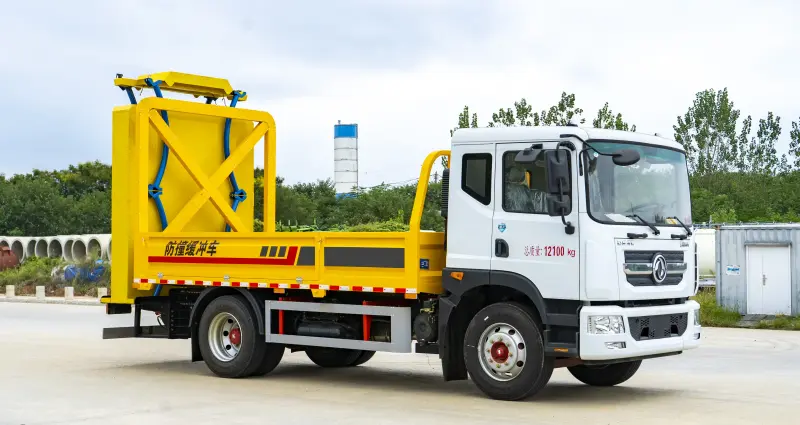
Table of Contents
What is a Truck Mounted Attenuator?
A Truck Mounted Attenuator (TMA) is a specialized safety truck. It has a strong part that soaks up energy. TMAs are made to keep people, tools, and drivers safe in dangerous road areas. These areas include road building, fixing highways, and cleaning up after accidents. The main job of a TMA is to take in the energy from a crashing car.
How does TMA Enhance Safety in Work Zones?

The attenuator part (usually made of aluminum honeycomb, curved aluminum tubes, or composite materials) bends slowly when hit. This helps make the crashed car less damaged.
TMAs use two main ways to keep people safe: soaking up crash energy and warning drivers.
First, it acts like a big cushion between fast cars and workers. The truck mounted attenuator is placed at the start of the work area to make a “safety space.” When a car hits it, the energy-soaking part bends in a slow, controlled way. This turns the crash energy into bending, which makes the crash less strong.
Second, new TMAs have warning systems to stop crashes before they happen. Bright LED arrow signs, flashing lights, and radar detectors work together to tell drivers about work areas ahead. Some fancy models even send messages to slow down or beep in cars if drivers aren’t paying attention.
Also, the TMA moves with the workers. This means protection never stops, even when the work area moves—like when fixing highways or bridges. It also makes other dangers smaller. Unlike hard barriers that might make cars spin or throw pieces, the TMA’s bendable design keeps the crash contained. This stops flying parts from hurting workers or other drivers. For slow crashes, many TMA parts can be used again after small fixes. This keeps everyone safe without long stops at work.
Good TMAs follow international rules like EN 1317 road safety barrier standards. These TMAs can cut crash deaths by up to 85%.
What are the Applications of Truck Mounted Attenuator?

A Truck Mounted Attenuator (TMA) works well if it can take in a lot of crash energy. There are three main types. They are different because they protect in different ways:
Low-energy TMA (50 kJ to 80 kJ) is for city streets, neighborhoods, and parking lots. Cars here go slower than 60 km/h. These small TMAs are on light trucks. So they can move around easily. They keep workers safe when they fix sidewalks or utility lines.
Medium-energy TMA (80 kJ to 100 kJ) is for suburban roads and regional highways. Cars here go 60-80 km/h. These are often used when people resurface roads or put in traffic lights. Medium-speed crashes might happen here.
High-energy TMA (100 kJ or more) is the strongest. They are used on highways, freeways, and airport runways. Cars here go faster than 80 km/h.
Best 4-Step Checklist for Selecting High-Quality TMA
Step 1. Verify certification & compliance.
Check that the TMA follows your area’s rules. For example, North America uses MASH 2016. Europe uses the ECE R29 vehicle safety certification. The Eurasian Economic Union uses EAC certification. Ask for official crash test papers. These papers should have full-size crash data and help you avoid bad products.
Step 2. Align the attenuator rating to your scenario.
First, find out two important things about your work area: how fast cars might hit the TMA and how heavy those cars could be. Let’s say you work on a highway. You need 100 kJ TMA—no other choice! But if you fix city roads, a 60 kJ TMA is enough. Next, look at the truck under the TMA. Small trucks (3-5 tons) work with weak TMAs. Strong TMAs need big trucks (8-12 tons) to stay steady.
Step 3. Assess core components & durability.
Look at the squishy part on the front of the TMA. What’s it made of? There are two good kinds. First is aluminum honeycomb. It’s light, and you can use it again—cool! Second is steel-reinforced stuff. It’s super tough for bumpy places like deserts or mountains. Also, check if the TMA has a special coat to stop rust, like galvanization. This makes it last longer if you work by the ocean or in the snow!
Step 4. Assess additional safety features.
Choose trucks that have automatic emergency braking (AEB), backup cameras, and super bright reflective strips. These things help keep everyone safe!
What’s next?
In summary, truck mounted attenuators have become an integral safety component in road construction, offering a critical combination of energy absorption, mobility, and operational versatility. Investing in a high-quality TMA is not just a cost but a commitment to safeguarding the people and operations. If you’d like to make a smart investment in truck mounted attenuator, you can contact Chengli Group.