

Choosing the right fuel tanker truck capacity is a critical step for any fuel transportation business looking to control investment risk, improve delivery efficiency, and reduce long-term operating costs.
With capacity options ranging from 5,000L to over 40,000L, many buyers fall into the trap of assuming “bigger is better,” while overlooking how actual transportation needs, road conditions, and regulations should shape the decision.
This guide covers common fuel tanker truck capacities, applications, configurations, and specifications, plus the key factors to evaluate before buying—so you can choose what truly fits your operation.
Table of Contents
Fuel Tanker Truck Capacity and Transportation Efficiency
Fuel tanker truck capacity directly affects transportation efficiency, especially when the vehicle is used for long-distance or high-volume fuel transportation.
For long-distance transportation, a larger tank can carry more fuel per trip and reduce the number of deliveries required. For example, a 40,000L fuel tanker semi trailer can transport a large volume of fuel in one operation, making it suitable for bulk fuel transportation between cities, fuel distribution centers, and large industrial areas.
However, capacity is only one part of transportation efficiency.
A larger tanker may also involve:
- Higher vehicle purchase cost
- Increased fuel consumption
- Higher maintenance costs
- Greater requirements for roads and bridges
- More difficult maneuverability in congested areas
- Higher requirements for loading and unloading facilities
Therefore, the most efficient solution is not necessarily the largest tanker. It is the vehicle that matches your actual fuel demand, transportation route, and operating conditions.
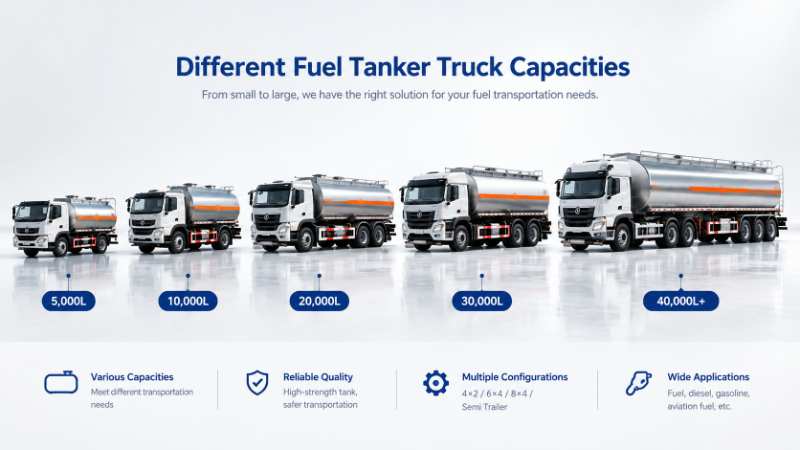
Fuel Tanker Truck Capacity Chart by Model
The following fuel tanker truck capacity chart provides a general reference for common configurations and applications:
| Fuel Tanker Truck Type | Typical Capacity Range | Suitable Application | Key Advantage |
| 4×2 Fuel Tanker Truck | 5,000L–15,000L | Urban fuel delivery, gas stations | Compact size and easy maneuverability |
| 6×4 Fuel Tanker Truck | 15,000L–30,000L | Regional fuel transportation | Balance between capacity and operating cost |
| 8×4 Fuel Tanker Truck | 30,000L+ | Mining, industrial and large-scale fuel supply | High transportation efficiency |
| Fuel Tanker Semi Trailer | 40,000L+ | Long-distance bulk fuel transportation | Large loading capacity |
Actual available capacity and vehicle configuration may vary according to chassis, axle configuration, local regulations, and customer requirements.
How to Choose Fuel Tanker Truck Capacity for Different Industries?
There is no single fuel tank capacity for tanker truck that is suitable for every application. Different industries have different fuel consumption levels, delivery distances, and operating environments.
1. Urban Fuel Delivery and Gas Station Supply
For urban fuel distribution, flexibility is often more important than maximum loading capacity.
Fuel distributors may need to deliver fuel to multiple gas stations or customers every day. The truck may also need to operate on narrow roads, congested streets, or locations with limited turning space.
For these applications, 5,000L, 10,000L, and 15,000L fuel tanker trucks are common capacity options.
A 4×2 fuel tanker truck can provide good maneuverability while keeping operating and maintenance costs relatively manageable.
2. Regional Fuel Transportation
For transportation between cities, fuel terminals, and distribution centers, buyers normally need to balance loading capacity and road adaptability.
A 15,000L–30,000L fuel tanker truck can provide more fuel per trip while maintaining good flexibility for regional transportation.
A 6×4 configuration is suitable for applications such as:
- Commercial fuel transportation
- Fuel station supply networks
- Regional fuel distribution
- Industrial fuel delivery
3. Mining and Large Industrial Projects
Mining areas, construction projects, and large industrial sites often have continuous and high fuel demand.
Mining trucks, excavators, loaders, generators, and other heavy equipment require stable fuel supply. In these environments, a large-capacity fuel tanker can reduce delivery frequency and improve fuel supply efficiency.
30,000L and above solutions may be considered for large-scale fuel transportation, particularly when transportation distances are long and road conditions can support heavy vehicles.
4. Long-Distance Bulk Fuel Transportation
When the main objective is transporting a large amount of fuel over long distances, a fuel tanker semi trailer can provide a much larger loading volume than a standard rigid tanker truck.
A 40,000L+ fuel tanker semi trailer capacity is suitable for bulk fuel transportation between major fuel distribution centers and industrial areas, subject to local weight and safety regulations.
Recommended Capacity by Application
| Application | Recommended Capacity | Suitable Model | Key Advantage |
| Urban fuel delivery | 5,000L–15,000L | 4×2 Fuel Tanker Truck | Flexible operation in urban areas |
| Gas station supply | 8,000L–15,000L | 4×2 Fuel Tanker Truck | Easy maneuverability and frequent delivery |
| Regional fuel transportation | 15,000L–30,000L | 6×4 Fuel Tanker Truck | Good balance between capacity and road adaptability |
| Mining and industrial fuel supply | 30,000L+ | 8×4 Fuel Tanker Truck | Suitable for high and continuous fuel demand |
| Long-distance bulk transportation | 40,000L+ | Fuel Tanker Semi Trailer | High volume per trip |
Road Conditions and Regulations Affect Fuel Tanker Truck Capacity
When choosing a Fuel Tanker Truck, capacity should be considered together with road conditions, vehicle dimensions, gross vehicle weight, and local transportation regulations.
A large-capacity tanker may improve transportation efficiency, but it also requires suitable infrastructure.
For example, a 40,000L fuel tanker semi trailer may be suitable for highway transportation between fuel terminals, but it may not be practical on roads with low bridge weight limits, narrow sections, sharp turns, or difficult terrain.
Before selecting a high-capacity tanker, check:
- Road width and turning space
- Bridge and road weight limits
- Maximum permitted GVW
- Axle load regulations
- Vehicle length and height restrictions
- Local fuel transportation regulations
- Safety and certification requirements
- Local emission standards
Different countries may also have different requirements for Euro emission standards, vehicle dimensions, safety equipment, and hazardous-goods transportation.
Therefore, a tanker configuration suitable for one market may need to be adjusted before being exported to another country.
Typical Fuel Tanker Truck Specifications
Capacity is only one part of the vehicle specification. When comparing different fuel tanker truck sizes, buyers should also check the tank structure, chassis, engine, pump system, and safety equipment.
1. Chassis and Drive Configuration
Common configurations include:
- 4×2 – suitable for urban and light-to-medium fuel distribution
- 6×4 – suitable for regional and heavier fuel transportation
- 8×4 – suitable for high-capacity rigid tanker applications
- Tractor + tanker semi trailer – suitable for long-distance bulk transportation
Chassis selection should consider payload requirements, road conditions, local maintenance resources, and spare-parts availability.
2. Tank Material and Structure
Common tank materials include:
- Carbon steel
- Stainless steel
- Aluminum alloy
The appropriate material depends on the transported liquid, local regulations, durability requirements, and budget.
Important tank specifications may include:
- Tank volume
- Tank plate thickness
- Head thickness
- Baffle thickness
- Number of compartments
- Manhole configuration
- Bottom valve
- Internal and external surface treatment
For example, a multi-compartment tanker can be configured to transport different fuel products separately, depending on the application and regulatory requirements.
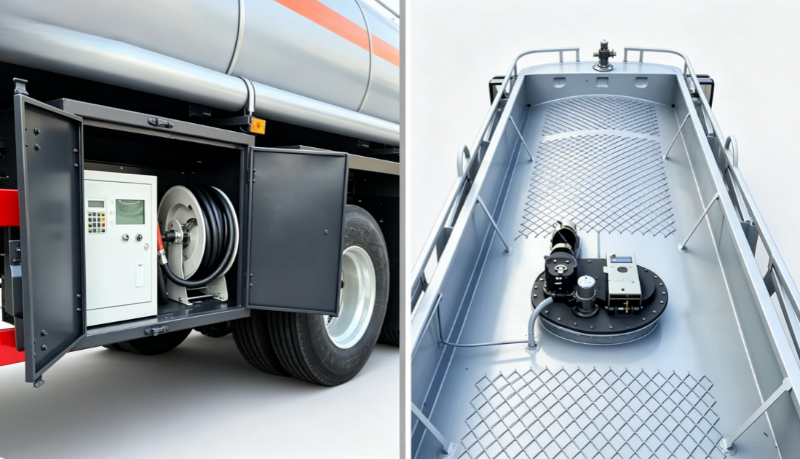
3. Pump and Fuel Dispensing System
Depending on the application, a fuel tanker can be equipped with different pumping and dispensing systems.
Optional equipment may include:
- Fuel pump
- Flow meter
- Fuel dispenser
- API couplings
- European standard manhole
- Bottom loading system
- Emergency shut-off system
- Anti-static equipment
The pump flow rate should be selected according to the customer’s loading and unloading requirements.
4. Engine and Emission Standard
Engine power is particularly important for heavy-duty fuel tanker trucks operating with high gross vehicle weight or on challenging terrain.
Common factors to consider include:
- Engine horsepower
- Maximum torque
- Fuel consumption
- Emission standard
- Transmission
- Axle configuration
A higher-horsepower engine can provide stronger performance under heavy loads and on slopes, but more power is not automatically better if it significantly increases operating costs without providing a practical benefit.
Beyond Capacity: Chassis, Engine, Tank and Safety
A fuel tanker truck is a complete transportation solution rather than simply a tank mounted on a chassis.
Chassis
The chassis should match the required capacity, road conditions, payload, and local service network. Depending on the market, buyers may consider brands such as HOWO, SHACMAN, Dongfeng, Foton, and other commercial vehicle chassis.
Engine
Engine power should match the actual operating conditions. Heavy loads, long-distance routes, and mountainous areas may require stronger power and torque.
Tank Structure
Tank material, thickness, compartment design, welding quality, and surface treatment all influence the durability and safety of the tanker.
Different liquids may also require different tank configurations. Diesel, gasoline, aviation fuel, and other liquid products should not automatically be assumed to require the same tank design.
Safety Equipment
Fuel transportation requires appropriate safety equipment. Depending on the configuration and market, a fuel tanker may include:
- Anti-static system
- Emergency shut-off devices
- Safety valves
- Fire extinguishing equipment
- Reliable pumping system
- Grounding equipment
- Safety protection accessories
Maintenance and After-Sales Support
For commercial fuel transportation, downtime can directly affect business operations.
Before purchasing, consider spare-parts availability, maintenance support, warranty terms, and technical assistance in the destination market.
Conclusion
The right Fuel Tanker Truck is not necessarily the largest one. The most suitable solution is the configuration that matches your actual fuel demand, transportation route, road conditions, legal requirements, and operating budget.
By evaluating fuel tanker truck capacity, chassis configuration, tank structure, pumping equipment, safety systems, and local regulations together, you can select a tanker that is better suited to your business and long-term operating requirements.
Contact CLW today to get detailed specifications, technical support, and a customized quotation for your Fuel Tanker Truck project.
Frequently Asked Questions About Fuel Tanker Truck Capacity
What is the most common fuel tanker truck capacity?
There is no single capacity that is suitable for every market. Common configurations range from approximately 5,000L to 30,000L for rigid fuel tanker trucks, while larger fuel tanker semi trailers can provide 40,000L or more, depending on local regulations and vehicle configuration.
How much fuel can a 40,000L tanker semi trailer carry?
A 40,000L tanker is designed with a nominal tank capacity of approximately 40,000 liters. However, the legally permitted payload depends on the tanker’s tare weight, fuel density, axle configuration, and local GVW and axle-load regulations.
What is the difference between 4×2, 6×4, and 8×4 fuel tanker trucks?
The main difference is the chassis and drive configuration. 4×2 models are generally more maneuverable and suitable for urban fuel delivery. 6×4 models provide greater load-carrying and traction capability for regional transportation. 8×4 models are designed for higher-capacity rigid tanker applications and require suitable road and weight conditions.
Can a large fuel tanker truck operate in cities?
It depends on the vehicle dimensions, weight, road conditions, and local regulations. A large tanker may carry more fuel per trip, but it can be harder to maneuver in congested urban areas and may be subject to restrictions on vehicle size, weight, or hazardous-goods transportation.
What regulations affect fuel tanker truck capacity?
Regulations may cover maximum gross vehicle weight, axle load, vehicle dimensions, emissions, hazardous-goods transportation, tank construction, safety equipment, and certification. Requirements vary by country and sometimes by region, so the final vehicle configuration should be confirmed according to the destination market.
What factors should I consider besides tanker capacity?
Besides capacity, consider the chassis, engine power, tank material, tank thickness, compartment configuration, pump flow rate, safety equipment, emission standard, road conditions, local regulations, and after-sales support.
