

A reefer trailer can be a useful investment if you have regular loads that need temperature control. But the purchase only makes sense when the trailer fits your cargo and earns enough to cover its costs.
Two trailers with similar cargo space can come with different cooling systems, body construction and service support. Compare their equipment lists and operating costs.
Before ordering, you need to know what the price includes, how much cargo will actually fit, and who can repair the cooling unit along your routes. The five sections below explain what to check.
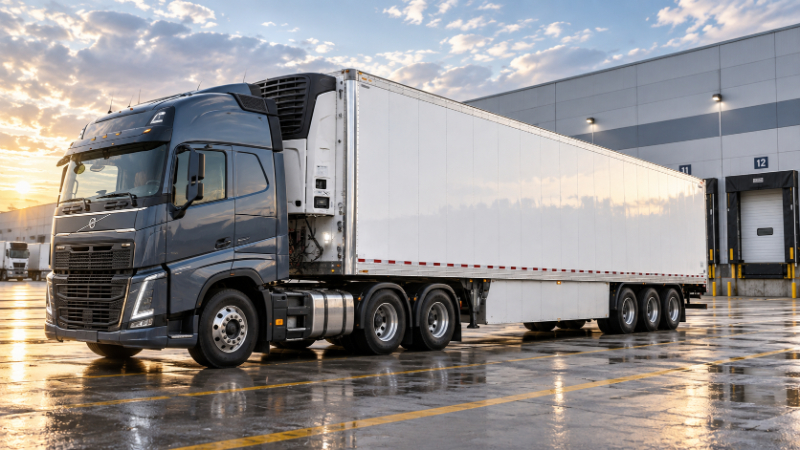
Table of Contents
What Are Reefer Trailers?
These are insulated trailers fitted with refrigeration equipment. They carry goods that need controlled temperatures, such as chilled food and frozen products. The insulation slows heat entering the body, while the cooling system and circulating air help maintain the required conditions.
A reefer semi trailer, also called a refrigerated semi-trailer, connects to a tractor unit. You need a compatible tractor as well as the insulated trailer and its refrigeration equipment.
Good loading practices matter as much as the equipment. Carrier advises operators to pre-cool the body, load products at the correct temperature, and keep the airflow clear. Load goods at the required transport temperature rather than relying on the unit to cool warm products during the journey.
Ask your customer for the required transport temperature before choosing a system. “Food delivery” is too broad: a load of frozen fish and a load of fresh vegetables can require very different conditions.
When Is Buying a Reefer Trailer Worthwhile?
Buying a reefer trailer is easier to justify when you have repeat customers, regular loads and predictable routes. If demand lasts only a few weeks each year, compare renting or paying a transport company before committing to ownership.
How many paid trips can you expect each month? How often will the trailer return empty? Will you still have work outside the busy season?
Build a budget with three parts:
| Cost group | What to include |
| Getting started | Trailer, delivery, import costs, registration and any tractor purchase |
| Running the operation | Driver, road fuel, cooling energy, tolls, cleaning and insurance |
| Keeping it available | Scheduled service, tyres, repairs and replacement transport during downtime |
Compare ownership, rental and outsourced transport over the same period and for the same amount of work. Include finance costs and expected resale value where relevant. Avoid counting both the full purchase price and depreciation as separate costs in the same calculation.
For a simple example, suppose your operation has USD 1,000 in fixed monthly costs. At 20 paid trips, that is USD 50 per trip. At five trips, it becomes USD 200. These hypothetical figures show how usage affects cost per trip. Budget for preventive maintenance, using running hours and service history to plan work.
Choosing the Right Reefer Trailer Size and Cooling Setup
1. Start with your load
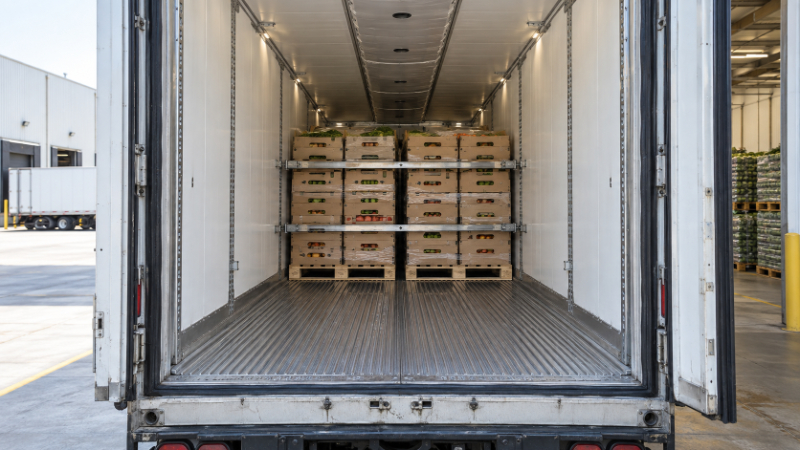
If a quotation lists 82 m³, confirm that this means internal cargo volume, measured inside the insulated body, rather than volume calculated from external dimensions. Internal volume alone does not establish legal payload or pallet capacity.
Send the supplier your pallet length and width, loaded height, weight per pallet and quantity per trip. Ask for a loading layout based on the actual internal dimensions. Leave the required space for air circulation and load securing.
Manufacturer specifications show why this matters. Schmitz Cargobull lists different internal widths and pallet capacities for its S.KO COOL range, with dimensions depending on the specification and applicable rules. Its figures should not be assumed to apply to a CLW model.
Also confirm the door opening, floor loading limit and empty weight. A load may fit inside the body yet exceed an axle or vehicle weight limit. Check access to your customers’ yards and unloading points too.
2. Match the cooling system to the journey
Give the supplier the required cargo temperature, expected outdoor temperature, trip length and number of delivery stops. A sealed journey between warehouses differs from a route with repeated door openings.
Ask for the cooling unit’s exact model and its capacity at your required operating conditions. A minimum temperature printed on a brochure is not enough to assess the whole trailer’s performance on your route.
If all goods need the same temperature, one zone may be enough. Mixed chilled and frozen loads need a system designed to control each compartment. For example, Schmitz Cargobull’s multi-temperature equipment uses insulated partitions and additional evaporators, which cool the air inside the body. A partition alone does not provide independent temperature control. Ask the supplier to confirm the temperature range, cooling capacity and airflow arrangement for each compartment.
How Much Is a Reefer Trailer?
To get a useful price, request a written quote for your required cargo volume, temperature and delivery destination. Ask the supplier to separate the basic equipment, optional extras and delivery charges. Compare offers on the same basis.
When comparing offers, ask every supplier to complete the same checklist:
| Item | What the quotation should state |
| Refrigeration | Unit model, installation and included accessories |
| Insulated body | Internal dimensions, panel construction, floor and doors |
| Running gear | Axles, suspension, brakes and tyres |
| Options | Temperature recorder, partitions, tail lift and remote monitoring |
| Delivery terms | EXW, FOB or CIF, with the named location or port |
| Support | Warranty coverage, exclusions and service arrangements |
Confirm whether refrigeration equipment, freight, insurance, duties and taxes are included or charged separately. A headline price may not cover the full cost of getting the reefer trailer ready for work.
Running costs also deserve a written estimate. For a diesel cooling unit, estimate fuel spending from average consumption per operating hour, monthly running hours and local diesel prices. Ask what conditions the consumption estimate assumes. Road distance alone will miss cooling time spent waiting at a warehouse.
If your depot has suitable power, ask about electric standby: an option that allows compatible equipment to use an external electricity supply while parked. Carrier recommends using built-in standby where available. Check power compatibility and compare local energy costs before expecting savings.
What to Verify Before Ordering a Reefer Trailer

1. Ask for evidence of performance
Request a cooling test record showing the outdoor temperature, starting temperature, target temperature, test duration and whether the body was empty or loaded. An empty-body test does not, by itself, prove performance on a full delivery route.
Ask how temperatures will be recorded during transport and whether your customer needs downloadable records. Agree on the inspection and acceptance process before paying the balance.
2. Inspect the body and service history
Check door seals, panel joints, floor condition and signs of damage or water entry. Look at the air ducts and confirm that the planned load will not block them.
For used equipment, ask for refrigeration running hours, maintenance records and major repair history. Carrier recommends servicing refrigeration equipment according to running hours. Age alone gives an incomplete picture. New equipment still needs an inspection and clear warranty terms.
3. Confirm local service and spare parts support
Ask which workshop can service the chosen unit near your normal routes. Confirm availability and lead times for filters, belts, sensors and door seals. Also establish who handles claims for the cooling unit and who handles the trailer body.
4. Compliance Checklist
Check requirements for your destination, cargo and route before ordering. Ask the importer and relevant authorities to confirm:
- Food hygiene: cleaning procedures, suitable interior surfaces and measures to prevent contamination. HACCP is a food safety management system, not a universal vehicle certificate.
- ATP applicability: whether the planned international transport of perishable food falls under the ATP agreement, and which equipment certification is required. Do not assume the same requirement applies worldwide.
- Temperature records: required recording intervals, sensor accuracy, calibration evidence and record retention. Confirm the logger meets both local rules and customer requirements.
- Border and vehicle documents: Reefer trailer import approval, registration, duties and taxes. Separately confirm any health certificates, quarantine inspections and customs documents needed for the food cargo.
Conclusion
A reefer trailer can be a worthwhile investment when you have regular loads and the right setup for your cargo. Before buying, check the usable space, cooling capacity, running costs and local service support. Compare complete quotations, and make sure your budget still works during quieter months.
Planning to expand your cold chain business?
Contact CLW for your customized solution. Tell CLW what you carry, the temperature you need, your usual load size and your destination country. We can help you compare suitable configurations and provide a detailed quotation based on your requirements.
