

Buying an electric garbage truck raises three worries. Will the battery last the whole shift? Is the body big enough to cut landfill trips? Can the truck handle hills and heavy loads? The answer depends on your route, not on a single big number like 400 kWh or 800 kWh.
This guide shows you how to choose a High-Capacity Electric Garbage Compactor Truck in four steps: battery, body size, power, and charging. You will also get a simple range table you can adapt to your own route.
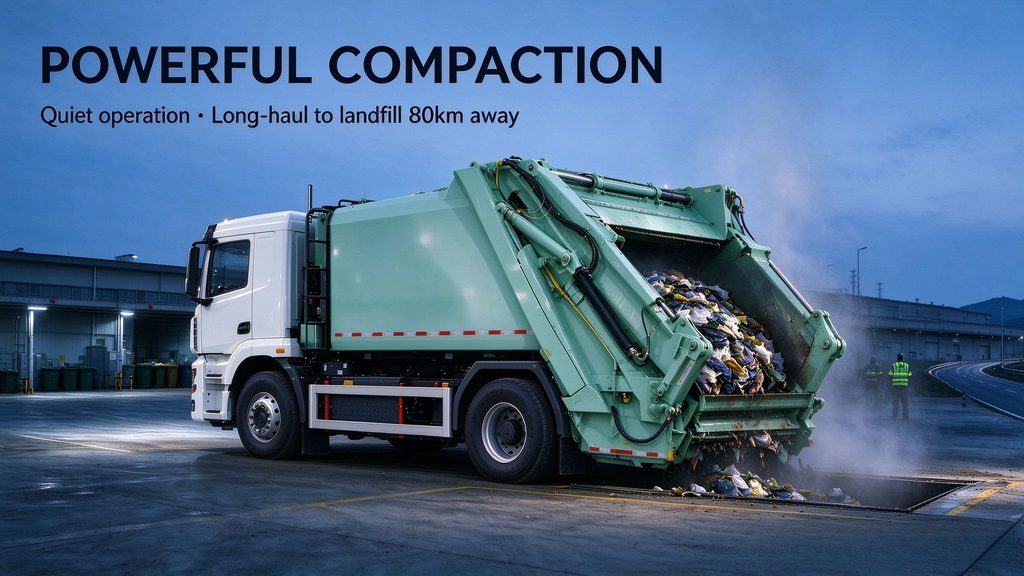
What Makes a High-Capacity Electric Garbage Compactor Truck Different?
A High-Capacity Electric Garbage Compactor Truck carries a large body (about 19 to 32 cubic yards or more) and a large battery (400 kWh and above). It is built for long hauls to the landfill, not only for short neighborhood routes.
Distance Is Not the Whole Story
An electric refuse truck that drives 80 km but stops 800 times has done far more work than its odometer shows. Every stop means acceleration, braking, lifting, and compaction.
The Battery Powers Two Jobs
In an electric refuse truck, the same battery runs the drivetrain and the compactor, so compaction intensity changes how much energy a route uses. That is why battery size must cover driving and compaction together.
Real-World Data Is Encouraging
One large study found that electric refuse trucks ran about 91% of the daily mileage of diesel ones, the highest ratio among the electric truck types it compared. Refuse routes are predictable, which suits electric trucks well.
How to Choose a High-Capacity Electric Garbage Compactor Truck?
Step 1: Match the Battery to Your Route
Use this simple formula:
Daily energy = driving energy + compaction energy + safety reserve
Know Your Two Key Numbers
For the example below, we use data from a 513 kWh truck:
- Driving: 1.2 kWh per km (about 1.9 kWh per mile), an average across empty and loaded trips, driving only
- Compaction: 33 kW while parked
For context, real-world data for electric trucks on urban roads has been reported at roughly 0.8 to 1.2 kWh per km. Heavy refuse trucks sit at the upper end of that range.
Example Range Table
We reserve 15% to 20% of the battery so the truck never runs dry. Compaction time is the total per day.
| Compaction time per day | Compaction energy | Driving range left |
|---|---|---|
| None | 0 kWh | about 340 to 360 km (210 to 225 miles) |
| 1 hour | 33 kWh | about 315 to 335 km (195 to 210 miles) |
| 3 hours | 99 kWh | about 260 to 280 km (160 to 175 miles) |
| 5 hours | 165 kWh | about 205 to 225 km (125 to 140 miles) |
Rule of thumb: each extra hour of compaction costs about 27 km (17 miles) of driving. These are calculated examples, not guaranteed range. Real results change with load, road, and weather.
Adjust for Your Conditions
- Loaded vs empty: 1.2 kWh/km is an average. One industry estimate says a full truck uses about 25% more energy than an empty one. If your loaded trip goes to the landfill, plan for a higher figure on that leg.
- Cold weather: Industry sources say cold can cut usable battery capacity by 20% to 30%. Add margin in cold regions.
- Route differences: One study found two routes of similar length used 23.2% different energy, mostly because of lifting, compacting, and stop-and-go work.
Step 2: Choose the Right Body Size
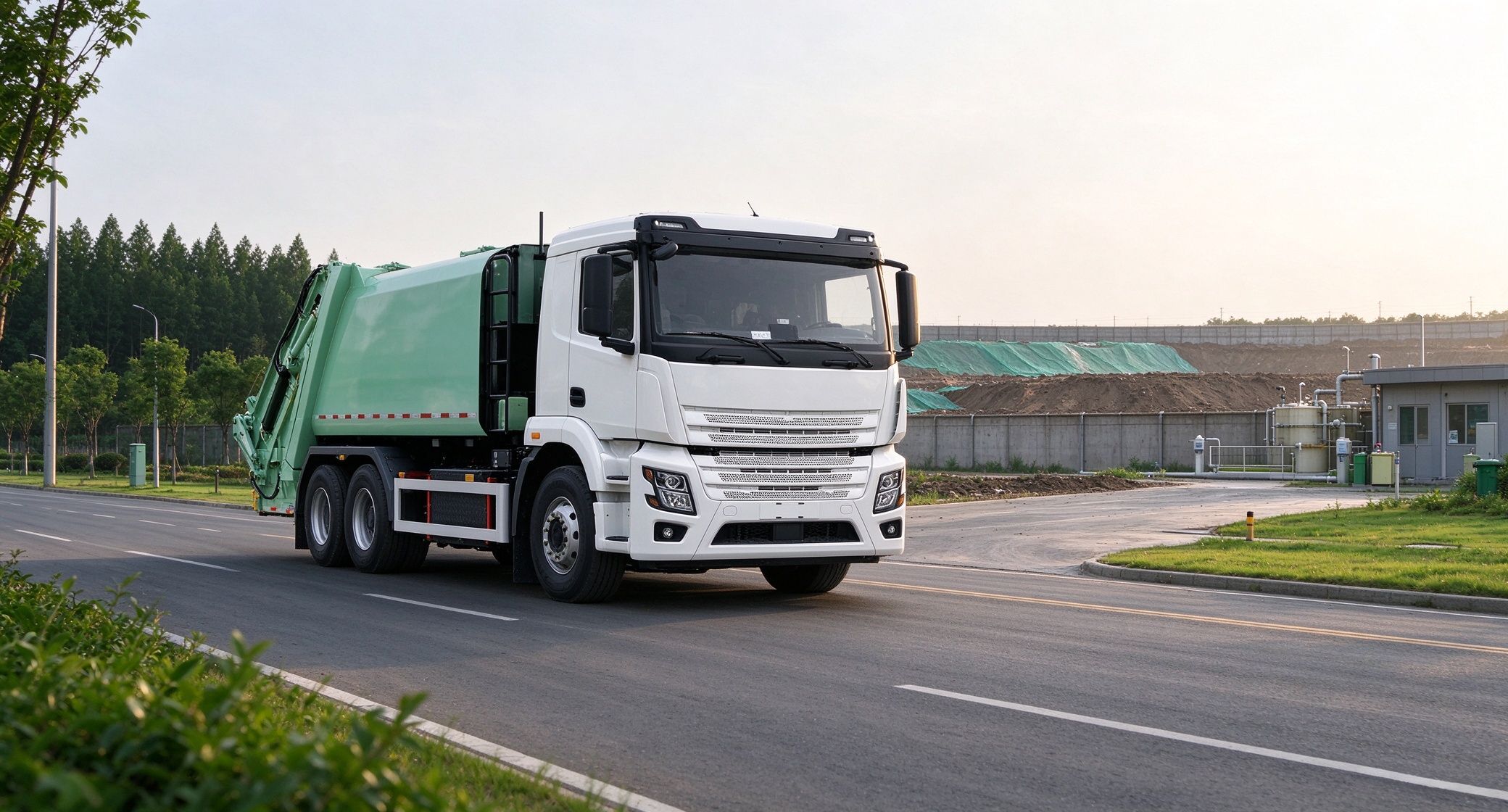
A bigger body means more waste per trip and fewer landfill runs. That is the main reason to choose a High-Capacity Electric Garbage Compactor Truck.
Sizes and Units
- 25 cubic yards is about 19 m³. This is a common size for the US market.
- 20 to 25 m³ (about 26 to 33 cubic yards) is common in other markets. Always confirm whether a quote uses cubic yards or m³.
What to Check Before Choosing
- Waste density: wet, dense waste fills the payload before the body is full.
- Payload and axle load limits: local rules cap the weight, so volume alone does not decide.
- Landfill distance: the longer the haul, the more a large body saves.
- Street width: a long wheelbase gives more body space but can affect turning. Ask for the turning radius.
For short-haul routes, electric payload capacity is reported to be close to that of diesel equivalents. Still, ask the manufacturer for the exact payload of your configuration.
Step 3: Check Motor Power, Hills and Altitude
Power for Loaded Hills
A loaded truck climbing out of a landfill or up a mountain road needs strong, steady power. Look for:
- Multiple motors or a dedicated electric drive axle built for heavy work
- A high peak power figure. For example, our Electric Garbage Compactor Truck uses four motors with 720 kW peak power
- A suspension and frame built for heavy loads and rough roads
Hills: Where Is the Landfill?
Electric trucks use more energy climbing and recover some going down. The direction matters:
- Landfill downhill: the loaded truck recovers energy on the way down.
- Landfill uphill: the loaded truck climbs, and the empty return recovers less.
Ask your supplier to test both cases on your actual route.
Altitude
Electric vehicles do not lose power at altitude the way combustion engines do, but long mountain climbs use noticeably more energy, so plan. In high-altitude cities, focus on total climb, temperature, and battery cooling, not on thin air.
Protection and Safety
Look for IP68 waterproof and corrosion protection, a battery rated up to IP69K, and a full-circuit high-voltage interlock that cuts power if a connector loosens or insulation fails. These matter for washdowns, rain, and dirty working environments.
Step 4: Plan Your Charging
Do You Need to Build Charging Piles?
In most cases, yes, at your depot. Refuse trucks return to the same yard every day, so overnight depot charging is the practical choice. Because the yard, route, and return point are known, the fleet operator controls charging schedules and parking.
Charging Time
A 60 kW DC charger can take a truck from 20% to 100% in roughly 6 to 8 hours, and a 150 kW charger cuts that to about 3 to 4 hours. These figures are for large batteries in general.
Example: A day with 100 km of driving and 3 hours of compaction uses about 219 kWh (120 kWh driving plus 99 kWh compaction). A 60 kW charger can refill that overnight in about 4 hours.
Grid Access Takes Time
- Fleets that deployed electric refuse trucks advise talking to the utility from the start, since utility timelines are outside your control.
- Grid capacity upgrades can cost millions and take months or years.
- Smart charging helps. Load shifting, power sharing, and local storage let fleets start earlier without waiting for large upgrades.
- If you cannot charge at your own site, charging-as-a-service may cost more but suits fleets with limited space or short leases.
Questions Buyers Should Confirm Before Ordering
- How many kilometers or miles does the truck drive each day?
- How many hours of compaction per day?
- Is the landfill uphill or downhill from the collection area?
- What is the highest altitude and the lowest temperature?
- What are the street widths and turning needs?
- What payload and body volume (in cubic yards or m³) do you need?
- Where will the truck charge, and how much power is available?
- Do you need OEM branding or special painting?
What’s Next?
The right High-Capacity Electric Garbage Compactor Truck matches your route, not a headline battery number. Start with your daily distance and compaction hours, then check body size, hills, and charging.
Ready to size the battery for your route?
Contact us and tell us your daily distance, compaction hours, and landfill location. Our team will prepare a customized configuration and quote, with shipping FOB, CIF, or CFR to your port.
Frequently Asked Questions
How many kWh does an electric garbage truck need?
It depends on distance, compaction time, load, terrain, and weather. Use daily driving energy plus compaction energy, then add a 15% to 20% reserve.
How far can a 513 kWh electric garbage truck go?
At 1.2 kWh/km driving-only consumption, the example table shows about 205 to 360 km (125 to 225 miles), depending on daily compaction time. Real range varies.
Does compaction use a lot of battery?
Yes. At 33 kW, one hour uses about 33 kWh. Three hours uses about 99 kWh.
Do I need my own charging station?
Usually yes, at the depot. Overnight charging fits daily routes. Talk to your utility early about grid capacity.
Can it work on hilly or high-altitude routes?
Yes, but climbs use more energy and descents recover some. Provide your route profile so the configuration can be checked.
What body size should I choose?
Choose based on waste density, payload limits, landfill distance, and street width. Confirm whether the volume is in cubic yards or m³.
